


The Charlotte Hornets have completely revamped the analytical side of their organization since new ownership came into the picture. Behind Rick Schnall and Gabe Plotkin (who I will be referring to as “Schlotkin” after Locked On Hornets’ Doug Branson coined the term), Jeff Peterson has adopted new-age basketball analytics.
They’ve even gone as far as utilizing AI within their draft process, as was widely covered back in February.
That’s not to say that the current Hornets brain trust is a slave to the numbers: that certainly isn’t the case: I’ll back up that stance in this article, as well.
But analytics are certainly a central figure in their talent evaluation, even if it’s not the invisible hand guiding how their team-specific big board looks.
In this article, I’m going to do a few things:
Create an analytics model based on known traits the Hornets prioritize.
Analyze where the model and where the 2025 Hornets’ draft class would have landed within it.
Use the model to predict who the Hornets could be targeting in this year’s draft class.
Look over the model’s flaws and where I could see the Hornets diverging from it.
Let’s get into it.
Methodology and How the Model Works
The main point I want to get across here is that the model is based on my subjective take on what I believe the Hornets value within their organization.
Those traits include 3-pointers, “want-to,” overall offensive efficiency, and feel for the game.
But how do you quantify all of those metrics into a single data point?
That’s the hard part.
I created three sections of data entry: hustle stats, offensive fit stats, and offensive efficiency stats.
“Hustle” stats are the most subjective of the three. To reflect what I consider to be statistics which are the product of effort and “want-to,” I recorded offensive rebounding percentage, steal percentage, and block percentage. It’s not perfect, but no data is.
In terms of “offensive fit” statistics, I used 3-point rate and (assist percentage minus turnover percentage). We know the Hornets value the 3-ball and quick decision-making.
For “offensive efficiency” stats, I used true shooting percentage and offensive box-plus-minus. Again, high-level statistics that measure offensive impact without getting too muddy.
For all seven statistics, I converted each metric into a percentile against the entire data set. Then, to get the “Hustle,” “Offensive Fit,” and “Offensive Efficiency” categories, I added the totals of those percentiles for each stat within the category.
Since hustle has three stats (max 300) and the other two have two stats each (max 200), I normalize each section to a 0–100 scale before averaging to the “Final Score”:
The model is designed to be easy to understand (while also being accessible with publicly-available data).
Here’s how the top-10 players shook out for the 2026 class. Keep in mind, I am not saying here that the Hornets are going to pick the players at the top of this list. I’ll explain why later in this article.

Okay, that’s interesting and all, but how do we know this model is sound?
Let’s see the 2025 draft class placed inside the 2026 data.
Note: The percentiles you’ll see here are different because they are based on the 36-player data set rather than the 32-player data set with just 2026 players.
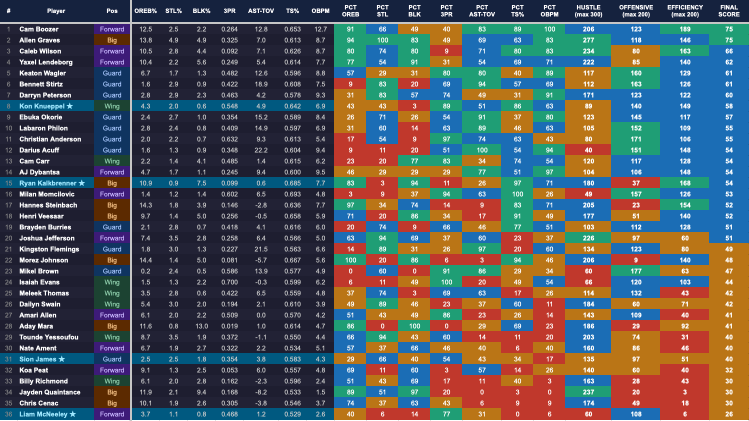
Well. That’s not great. the Hornets had four draft picks (one of which in the top-5) and only two of the players rank in the top-20. The other two rank in the bottom-6.
Well… Let’s take a deeper dive.
First, we’re going to divide the data set into four position groups: guards, wings, forwards, and bigs. You’ll notice positional clusters throughout, and this makes sense. Each position has its unique role. Bigs are going to perform better in hustle stats (due to block rate), while guards are going to be favored for offensive fit reason due to 3-point rate.
Because of this, we’ll divide it by position.


Well. Look at that, Kon Knueppel and Ryan Kalkbrenner rank high among their respective position. But Sion James and Liam McNeeley are still ranked last…
Again, the point I want to make here is that the Hornets will never be a slave to the data. But if you filter down to the “Hustle” metric for Sion James, and the “efficiency” metric for Liam McNeeley, you can find why the Hornets had interest in both players.


I think that there’s an argument to be made that once you get further down the draft board, you can look for standout traits rather than the overall “final score,” especially if you are trying to add a specific skill set to the team.
The model isn’t perfect, I won’t ever claim that it is. But I do think it’s at least part of the puzzle regarding who the Hornets might - or might not be interested in come draft time.
The model does prove to be predictive of the Hornets drafting tendencies. So what does it say about who Charlotte targets in the 2026 NBA Draft?
First, let’s identify archetypes the Hornets are likely to be interested in adding this offseason.
The biggest desire is for Charlotte to add a two-way power forward that can keep the flow of the offense in tact. There’s some frustration around Miles Bridges’ overall game and his tendency to be a ball-stopper offensively. I think most would agree that Charlotte needs a different long-term starter at the position.
Most would also agree that the Hornets need much more paint physicality. Moussa Diabate was an amazing story throughout 2025-26, but there’s reason to believe he’d be better suited as a backup big on a playoff-caliber roster.
Third, the Hornets could use more wing depth. Josh Green was phased out of the rotation towards the end of the season, and adding another connective piece that can hit 3-pointers and play defense is a rotation piece that almost every NBA team needs more of.
So we have our list of needs:
Two-Way Power Forward
Physical Center
3-and-D wing
Let’s start with power forward.

The obvious pick here is Yaxel Lendeborg, who graded out as the fourth overall player (and third forward) on the model. He had the fourth-best hustle metric and seventh-best efficiency metric in the model.
But it’s not very likely that Lendeborg is available to Charlotte with the 14th pick. There’s a decent likelihood he’s even taken in the top-10. But for our sake, he fits the cleanest into this category.
If he’s not available? That’s when Allen Graves becomes a lot more interesting.
Graves graded out as the single-best player on in the entire model.
He graded first in hustle, sixth in efficiency, and 14th in offensive fit. And while he is listed as a “big,” I do think Graves projects as more of a power forward than center at the NBA level, particularly after his combine measurements came in:


Graves will test well in almost every single analytics model, and though there are concerns about the level of competition he faced (and that he started only four college basketball games in his career), he does check every box: the need, and traits at that specific need.
I’d go as far as saying that Graves tested so well in the model that it’s difficult to exclude him from this prediction.
Model Prediction: Yaxel Lendeborg and Allen Graves will be high on the Hornets draft board.
Next, let’s talk about physical centers that could be in play for Charlotte.

Well start with Hannes Steinbach, who grades as the best center in the model. He’s a more specific type of player - one who’s particularly good scoring inside and grabbing rebounds. Steinbach is tied for the third-best hustle score in the group while adding a lot of offensive efficiency.
Steinbach would be a big, physical center presence with the potential to grow into a serviceable defender, and he’s projected to be taken in the Hornets’ draft range. He absolutely has to be on the shortlist.
Before his combine measurements came in, I was worried he’d be a tweener since his shot is a bit underdeveloped for a power forward, but I’m much more comfortable calling him a center after coming in at 6-11+ in shoes with a near-250 pound frame. That’s NBA-caliber.

There is another name, though.

If you sort the bigs by hustle rating, Jayden Quaintance rises to second. If the Hornets want a more physical big that does the little things and raises the floor of the defense, looking by who ranks best in hustle might be more accurate than just sorting bigs by final score.
There’s a bit of projection when it comes to Quaintance, but generally, he’s considered a game-changing defensive center prospect if the medicals come back clean.
He suffered a torn ACL that set his development back at Kentucky this year, but going into the season, Quaintance was viewed by many as a top-5 prospect in the class.
At Arizona State as a 17-year old, Quaintance averaged 9.4 points, 7.9 rebounds, 2.6 blocks, 1.1 steals, and 2.6 fouls.
That is ridiculous. If he were eligible for the 2025 NBA Draft, he would have been in contention with Khaman Maluach for the first center taken (and in my opinion, in consideration for a top-5 pick).
Model Prediction: Hannes Steinbach and Jayden Quaintance will be high on the Hornets’ draft board.
Finally, who are some wings that could be in consideration for the Hornets?
There really only is a single wing player that projects to be available in the Hornets draft range and is worth talking about here, and it’s Baylor wing Cam Carr, who graded out as the number one wing by a wide margin.

Carr leads all wings in efficiency, while modeling out to the middle-of-the-pack in terms of hustle and offensive fit. That’s a solid combination, and Carr brings the exact traits we talked about in what Charlotte might seek out on the wing in this specific draft: players who can hit 3-pointers and defend.

Carr is a late-breakout player who really turned it on at Baylor this past season, averaging 19/6/3 on 49/37/80 shooting splits. At surface value, that’s pretty good for a third-year wing.
It also doesn’t take into account just how poor Baylor’s team construction was, including the team had zero players from their rotation return from the prior season. It was so bad, in fact, that Baylor recruited former Hornets second-round pick James Nnaji to join the team mid-season.
Model Prediction: Cam Carr will be high on the Hornets’ draft board.
Players the model likes for the Charlotte Hornets, in no particular order:
Yaxel Lendeborg, F, Michigan
Allen Graves, F/B, Santa Clara
Hannes Steinbach, B, Washington
Jayden Quaintance, B, Kentucky
Cam Carr, W, Baylor
The model is not perfect.
The final thing I want to make clear in this article is that the model I created is not an exact science.
My interpretation of the data is completely subjective, as was the data I chose to use for it. By no means should this be taken strictly, and the whole reason I created this model was to think about the draft from an analytical perspective, favoring traits that I believe Charlotte values more than others.
The data itself is limited. There are only 32 players in the database, essentially only the ones I considered to be first-round prospects.
It’s also not geared to favor competition level or minutes played, which is a large part of the reason why Allen Graves grades so favorably.
There’s also an entire player missing! Karim Lopez didn’t play college basketball, so I excluded him from the data set. It’s hard to find NBL data for the specific stats needed for the model, so he’s excluded.
Still, there’s a really good shot the Hornets draft Lopez.
The data is career-based, which favors one-and-done prospects more than players who broke out later in their college careers.
All of this is to say that the work done here is extensive, yes, but also needs to be taken with a pinch of salt. There’s a lot of interpretation here, and by no means am I a full-fledged mathematician.
Still, I think there are worthy takeaways.
If you’re interested in going through the full dataset, you can access the spreadsheet HERE.