


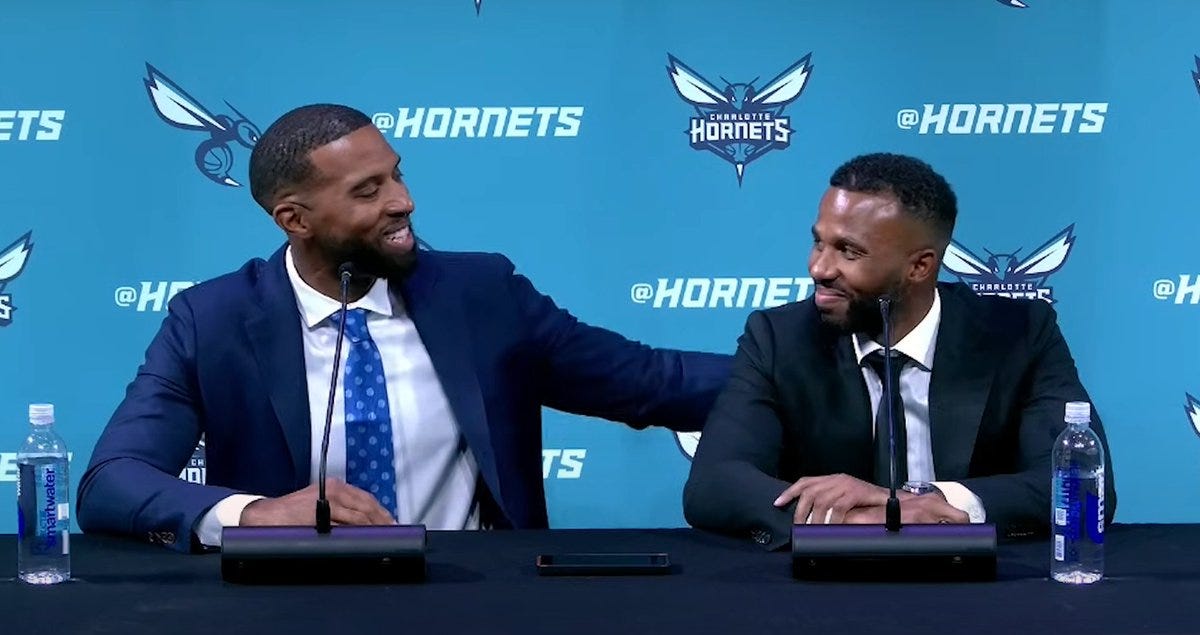
The Charlotte Hornets have been, without a doubt, one of the most impressive teams in the NBA since the turn of the new year. Since January 1st, the Hornets are 15-9 with one of the best net ratings in the league.
It has been a complete turnaround for a team that’s been towards the bottom of the NBA standings each of the past three seasons.
That begs the question, how?
There are many reasons the Hornets are suddenly ‘good’ now, most of which you probably already know. What I aim to do with this article is articulate the system that head coach Charles Lee has employed, why it’s effective, and how Jeff Peterson has gone about constructing the roster with players that fit Lee’s vision.
We’ll start with some background.
New Front Office Direction
Since Gabe Plotkin and Rick Schnall took over ownership of the Charlotte Hornets, they have completely overhauled the team's analytical approach.
Prior to 2023, it wasn’t exactly a secret that analytics weren’t a guiding factor in decision-making. I’m not saying it’s a bad thing, per se, but more so that it was one of many ancillary pieces of information that was considered.
But specifically since lead decision-maker Jeff Peterson took over the front office braintrust, analytics have come to the forefront.
Even going back to the 2024 draft, there were reports of Charlotte being interested in Kentucky guard Reed Sheppard, who reportedly was ranked #1 in several teams’ analytical models before the draft.
In fact, in the buildup to the same draft, the Hornets made an under-the-radar hire. The team created a new front office role: hiring Patrick Harrel as Vice President of Basketball Insights & Analysis.
So while the team may not have gotten Sheppard in 2024, they certainly hit on their first-round pick in 2025 with Kon Knueppel.
“The commercial impact was almost immediate, says Patrick Harrel, VP of Basketball Insights & Analysis at the Charlotte Hornets. ‘Within weeks, Invisible provided us with an AI draft strategy that gifted us Kon Knueppel, the #4 overall pick by the Charlotte Hornets in the 2025 NBA draft. He was named MVP of the NBA Summer League Championship game after leading the Hornets to victory. He scored 21 points in the final game, helping the Hornets defeat the Sacramento Kings. This win also marked the Hornets’ first-ever trophy and Summer League championship.’”
Update: Invisible Technologies updated the document following the publication of this article. The updated quote reads as follows:
Invisible’s computer vision models provided high-quality data that played a key role in validating our 2025 draft analysis. The insights we gained proved incredibly valuable to our decision-making and we are excited to continue to work together.”
So what does this mean?
The Hornets internally favor certain statistical (and biometric) profiles over others, which is part of the reason they have seen much more success as of late. Let’s get into those traits.
Three Point Rate
Above all else, the Hornets simply attempt more 3-pointers than their opponents. The Hornets attempt 41.6 3-pointers per game. That’s the fourth most in the NBA, only trailing behind the Golden State Warriors, Boston Celtics, and Portland Trail Blazers.
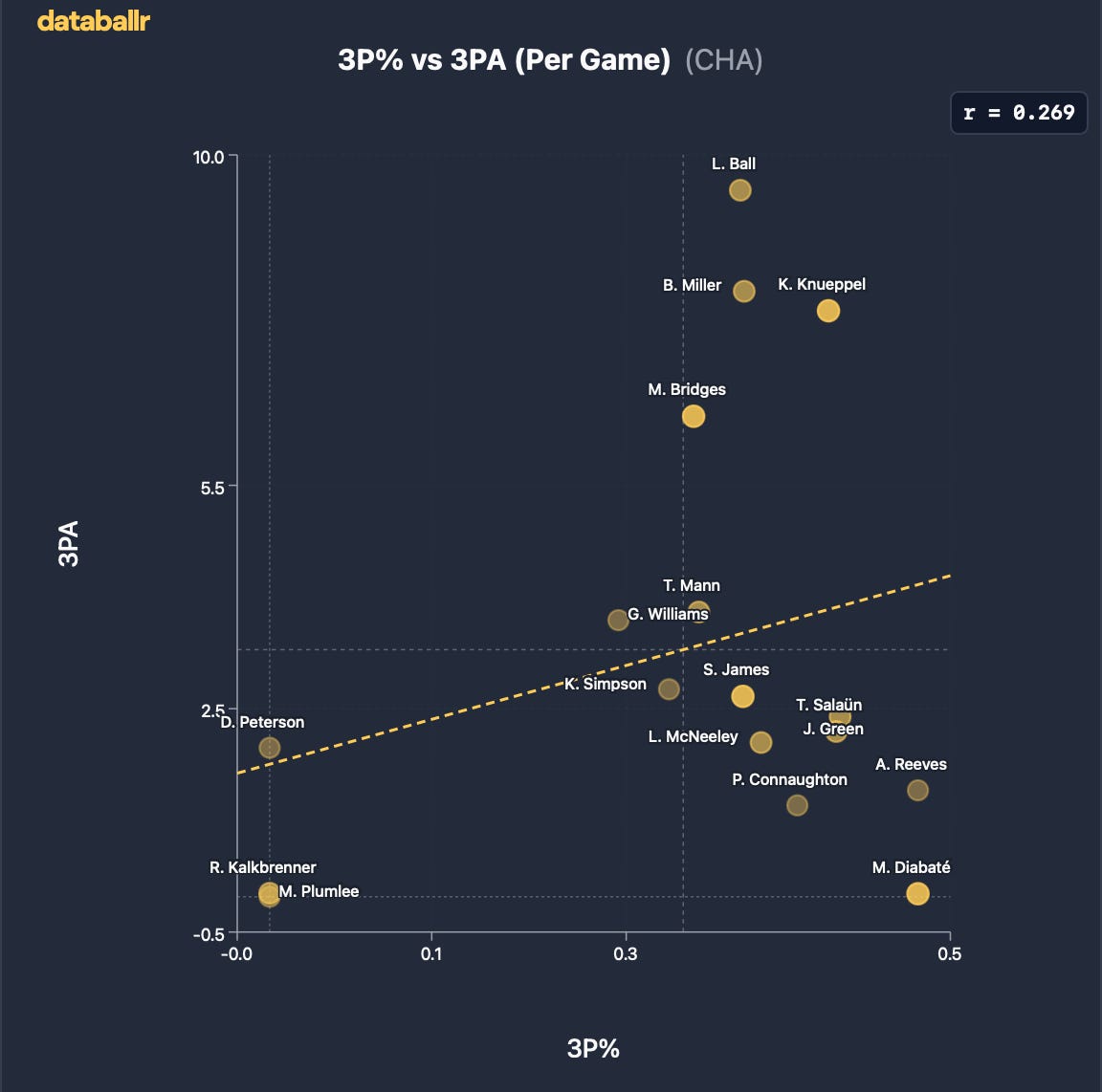
And despite being behind those teams in 3PR, Charlotte is actually more efficient on the shots they do take. Currently, the Hornets are the only team in the NBA to be both top-5 in 3PA and 3-point percentage.
That, as displayed when talking about the player acquisition strategy employed by Peterson and the front office staff, is no accident.
All of this is before Coby White, who averages 37% from three on 6.4 attempts per game throughout his career, has played a minute for the team. Jeff Peterson has already stated how White was a long-term acquisition - again, not exactly a marriage of convenience.
And considering where Liam McNeeley, Ryan Kalkbrenner, and Sion James thrived in the college game, this looks much more like a deliberate offensive effort to prioritize 3-point looks.
And if you have the shooters, it just mathematically makes sense to do so. As of the date that I’m writing this, each of LaMelo Ball (9.4), Brandon Miller (8.3), Kon Knueppel (8.0), and Coby White (7.2) are among the NBA’s top-20 players in 3-pointers attempted per game.
Here’s the catch, though. The Hornets aren’t just blindly lobbing 3-pointers at the rim. They’re consistently generating good looks. Per NBA.com, 43.4% of all the shots Charlotte takes are either “open” or “very open” 3-point attempts (basically 4+ feet of space or more). That’s… quite a lot.
But even then, if the shot isn’t falling, how do you maximize your chances of winning?
Offensive Rebounding
The other clear edge the Charlotte Hornets have over their opponents is their ability to simply grab more rebounds, particularly on the offensive end.
Over the last 15 games, the Hornets have the most offensive rebounds in the NBA per 100 possessions (14.6). This, as you probably already know, is in large part due to the impact of Moussa Diabate and Ryan Kalkbrenner.
And while those two have been particularly good, there are currently seven total Hornets players averaging 1.0 offensive rebounds or more, with Diabate leading the charge at 3.7 (this is the fifth-best mark in the league).
The Hornets’ offensive rebounding strategy is a particularly unique one, relying on tip-outs rather than outright boards.
Here’s a clip showing exactly what I mean. Brandon Miller misses a free throw, but Ryan Kalkbrenner, despite not being in the best position to grab the board, uses his length to tip it to where only Grant Williams can gain possession. He swings it back to Miller, who relocated and got a clean look.
Here’s another example. Ball misses a 3-pointer, but the defense crashes inward, the ball is once again tipped out by Kalkbrenner, and Ball gets another open look.
The Math
The Hornets have two priorities that feel simple but make all the difference when you have the talent to actually execute the scheme: possessions and points per possession.
If you hit more 3-pointers at a higher percentage than your opponent, you’re likely to win. But the other part of that equation is simply having more opportunities to make shots. The Hornets are 5th in points per possession over the last 15 games. They are 2nd in 3PM/possession and 1st in offensive rebounds/possession.
Put simply, the math works out in the Hornets’ favor most nights.
The Engine
LaMelo Ball has rapidly become one of the most under-appreciated players in the NBA. We went from his name being a part of trade “rumors” in late 2025 to Ball having a genuine and noticeable impact on winning.
There is something to be said about being the only player on the Hornets roster consistently creating looks for others. LaMelo Ball is averaging a career-high 9.5 assists per 36 minutes. His turnovers per 36 minutes are the lowest they’ve been in three seasons. The same can be said about Ball’s fouls per 36 minutes. By and large, we’re seeing LaMelo Ball’s most impactful season since he was an All-Star in 2022.
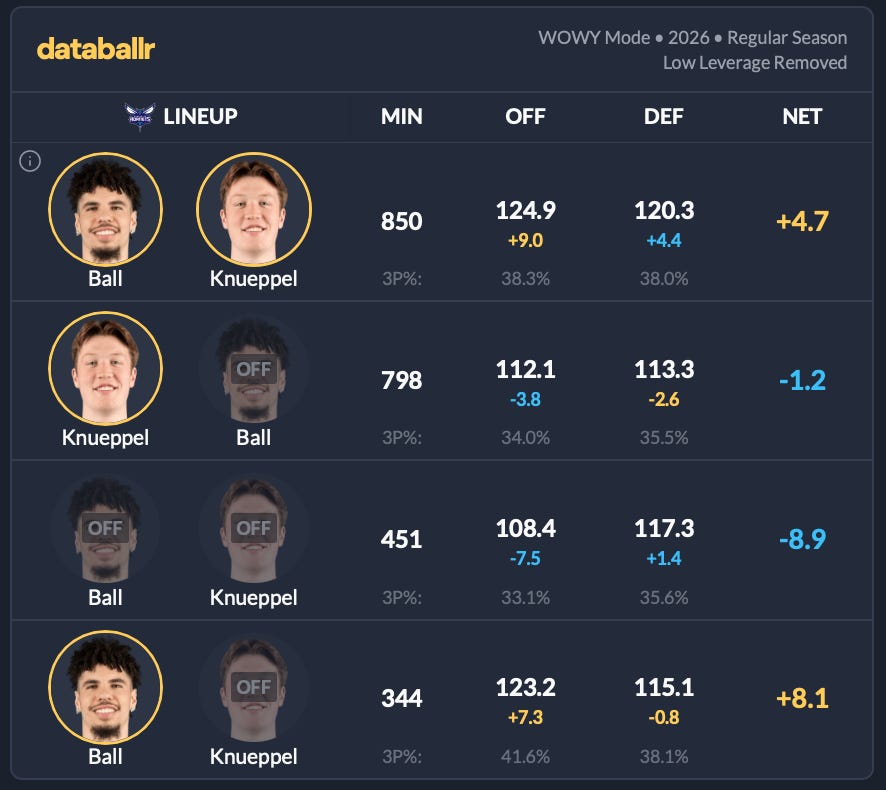
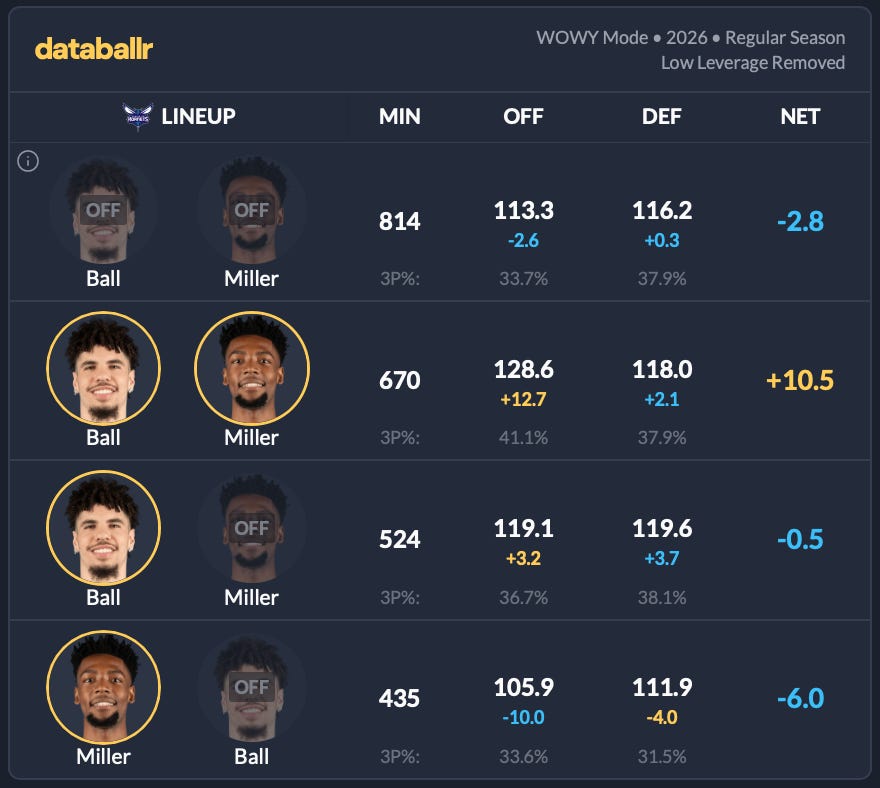
Moreover, the Hornets’ other two core players’ net rating drops dramatically without Ball on the floor.
Ball + Knueppel:
Ball + Miller:
So while all of these factors have individually contributed to the Hornets’ emergence this season, the combination of everything is a coordinated effort by the front office, coaching staff, and players to create a real, tangible identity that has been missing from Charlotte basketball for a full decade.
Seems worth noting out that Invisible Technologies changed the quote from Harrel in their white paper, probably as a result of the traction it was getting from this article. Here's the new excerpt that clarifies / downplays their input (including a final sentence that no longer makes sense):
"The commercial impact was almost immediate. “Invisible’s computer vision models provided high-quality data that played a key role in validating our 2025 draft analysis,” said Patrick Harrel, VP of Basketball Insights & Analysis with the Charlotte Hornets. “The insights we gained proved incredibly valuable to our decision-making and we are excited to continue to work together.” This win also marked the Hornets’ first-ever trophy and Summer League championship.
Great insight!