


DISCLAIMER: This written piece represents my analysis of publicly available behavior.
Kalshi, the “prediction market” platform in which most of its “trading volume” is centered around sports, has been creative in their advertising approach throughout their rise in popularity.
Throughout the early portion of the year on Twitter, Kalshi used an affiliate badge system with partnered influencers, putting their logo as a badge next to each account they partnered with.
It looked a bit like this:
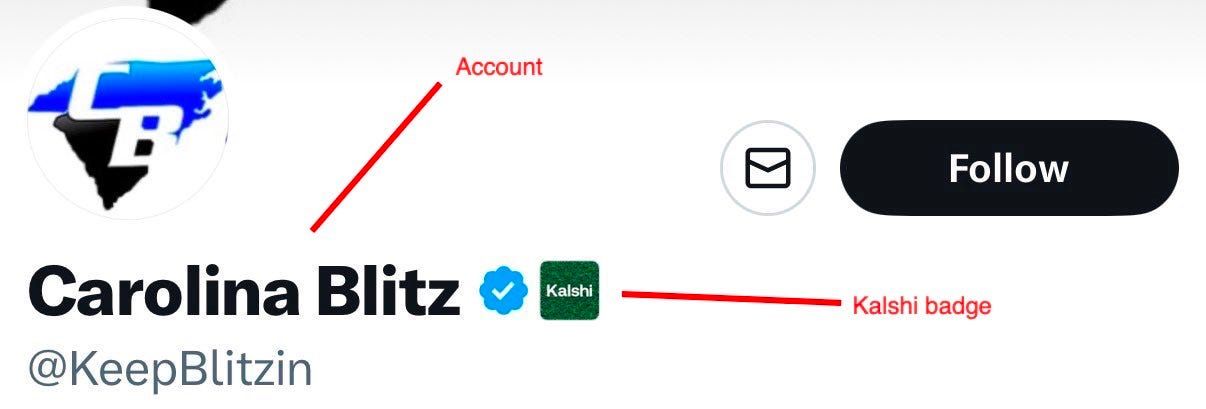
It’s important to note that many of the accounts that had such a badge were not employed by Kalshi, it was a paid partnership.
Many of Kalshi’s partners never disclosed the nature of the partnership. The FTC requires disclosure when a payment is tied to any sort of promotional activity. No disclosure appears on these posts.
Many of those deals worked like this:
Kalshi would approach the creator about a partnership.
The creator would agree, and Kalshi would give the creator an affiliate badge (pictured above).
In most instances, the creator would quote-tweet a Kalshi tweet, ultimately boosting its impressions and overall metrics. Some creators would also simply outright tweet about certain betting markets. An example of what that looks like is linked below. (Note: There is no way to verify if the account linked below was affiliated with Kalshi, other than the aforementioned badge).


Again, the important part here is that the nature of the Kalshi partnerships, at the time, many of which were undisclosed. The creator would receive the money and badge, but most never publicly shared that their quote tweets (or graphics like the one above) were posted due to the promotional nature of the creator-brand partnership.
That strategy by Kalshi was upended by Twitter back in February, so they had to pivot from that influencer partnership plan.
“Prediction-market platform Kalshi removed all affiliate badges on X/Twitter on Monday evening after the social media platform recently updated its paid partnerships policy to prohibit promotional deals with accounts that post gambling and sports betting content.
Twitter updated its paid partnerships policy last week to bar paid affiliate accounts that post about ‘gambling products and services (including lotteries, social casinos, sports betting, and other gambling-related content).’”
A Kalshi spokesperson said this to Front Office Sports in the same article:
“We’ve decided to remove Kalshi badges. People loved the badges and it was a fun way to engage the community, but it became too difficult to police, and people often confused badged accounts with Kalshi-endorsed messages. We’ll figure out other ways to make things fun for our traders.”
Since then, Kalshi appears to have been testing the waters. For a while, they would have creators use the same content-boosting strategy (quote tweeting), this time with the #KalshiPartner (or similar hashtag) tag attached to the post. An example of that is below:


And while this ultimately is still promoting a product akin to sports betting, at least it’s above board from an FTC perspective. The paid partnership is clearly disclosed.
The #KalshiPartner disclosures appear to have largely disappeared from recent posts.
Their current promotional structure appears to look like this:
Kalshi would approach the creator about a partnership.
The creator would agree.
The creator quote tweets a Kalshi tweet once a day (or of a similar cadence). In the instances documented here, no disclosure appears.
And before showing what the pattern looks like, it’s worth establishing that Kalshi approaching creators with this model is not speculation. Below is an example of Kalshi offering a creator $20 per quote tweet.


Below is a tweet from Kalshi on May 19th. It has 85 likes, 70 retweets, and 33 replies.
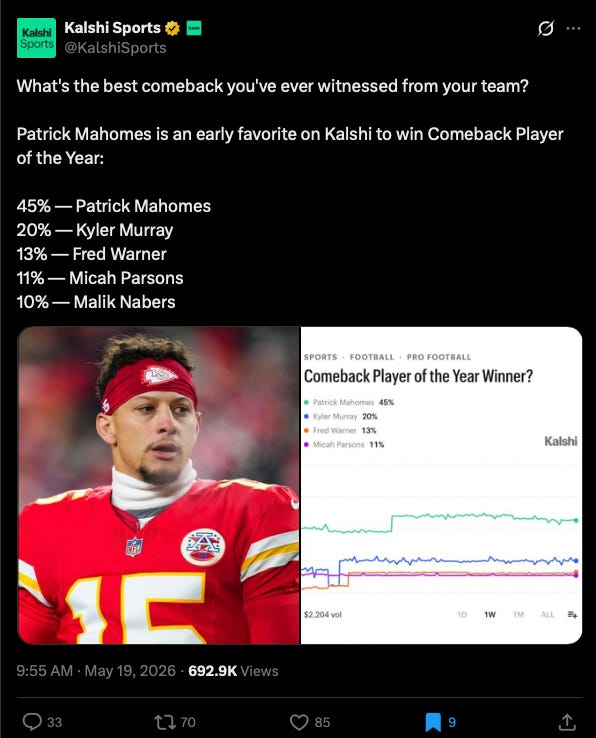
Almost every single retweet is a high-volume account quote tweeting Kalshi’s original post with either a video or photo designed to get engagement.
It’s why Kalshi’s post has nearly 700 thousand impressions but not even a hundred likes.
Kalshi has directly offered payment for this exact behavior before, as shown with that Twitter DM.
And I will note here that there are several creators who have marked their posts as a paid partnership.
Many of the accounts interacting with the tweet above do so with one of Kalshi’s tweets on a regular basis - multiple times per week. And it’s in the same style/format as the tweet above.
I’ll just use one account as an example.
Note: This is not an accusation of any accounts listed in the piece. It is an analysis of publicly available behavior.
All of these tweets have come in the past two weeks:


That’s a lot of consistency: the same accounts, posting the same format, on the same Kalshi tweets, multiple times per week.
Here’s another example.


The account above is posting the exact same type of content as the example previously mentioned, on mostly the exact same Kalshi tweets. No disclosure label appears on these posts.
What does the FTC require?
The FTC’s guidelines state that any material connection between a creator and brand (aka, a payment for an action, in this case, quote tweets) must be disclosed in a “clear and conspicuous” manner.
So even though there is no clear “endorsement” of Kalshi in any of the quote tweets, the act of quote-tweeting Kalshi’s content while being paid to do so (without disclosing such) can look like organic amplification from a sports-focused account.
Those viewing the content, unaware of the partnership, do not realize the creator is being incentivized to quote-tweet it.
If someone quote-tweets content on their own with no partnership, then no disclosure is needed. But if there is a payment tied to the action, that changes things.
Any activity that looks normal but is actually a paid promotion is deemed deceptive (and a violation of the FTC’s guidelines).
Why does this matter?
“Prediction markets” like Kalshi and Polymarket occupy a different category than other consumer brands. They’re attempting to advertise a place where people make financial decisions.
They advertise their product(s) as an investment opportunity rather than gambling. Undisclosed promotion for this type of company is much different than one for a sneaker or soda brand.
What I’ve shown here is a pattern of publicly available behavior that looks like paid promotion. There’s no mention of such a partnership from many creators who fall in line with this pattern, which would be misleading for their audience, viewers, and followers if there is, in fact, a paid partnership.
The entire reason the FTC requires disclosure is so audiences can evaluate content knowing whether a financial incentive actually exists. In most of the posts displayed here, that information is absent.