


Sitting at a crossroads this offseason, the Charlotte Hornets have a choice to make in this year’s NBA Draft: swing for the fences to target upside or pursue safer prospects.
The stakes are high for Charlotte this offseason, after falling one game short of the NBA Playoffs. On the cusp of establishing itself as a playoff team, the 2026 NBA Draft could be the step that pushes Buzz City over the line and into the playoffs. However, missing in the draft would almost certainly set the franchise back after making significant progress this year.
With a pair of first-round selections at No. 14 and No. 18, Charlotte is picking in a fascinating range. If history teaches anything about the middle of the first round, it’s that there’s always value to be found with players like Giannis Antetokounmpo, Bam Adebayo, and Alperen Sengun selected in this range. However, for every All-Star selected in this range, there are just as many busts. Hornets fans should be well aware of this after the franchise missed on Kai Jones in 2021.
For the Charlotte Hornets, I believe that the best course of action is to use both first-round selections on high-floor prospects. With LaMelo Ball on a max contract, Brandon Miller’s likely extension looming, and eventually an extension for Kon Knueppel all factored in, the Hornets’ roster is about to get expensive quickly. As showcased by the Oklahoma City Thunder’s model of injecting rookie talent to fill out rotation spots annually, having effective role players on rookie contracts is an incredibly valuable asset in team building.
It may seem counterintuitive to pass on the opportunity to swing for the fences twice and hope that one pick pays off. After all, adding a potential All-Star caliber player would almost certainly elevate the Hornets to be a clear playoff team. However, the odds of hitting on even one out of two of those boom or bust picks are slim.
To better understand the likely outcomes for boom or bust and safe prospects, I examined the 2016-2023 draft classes, classifying every prospect selected 14th through 18th as either a boom or bust, safe prospect, or somewhere in the middle based on pre-draft consensus. Then, focusing on the boom or bust and safe prospects, I noted each player’s outcome as a star, quality role player, or bust. I also excluded prospects from the 2024 and 2025 NBA drafts, as it is too early to know how those prospects will turn out. While the methodology requires some subjectivity in evaluating prospect outcomes, it gives a general sense of player outcomes.
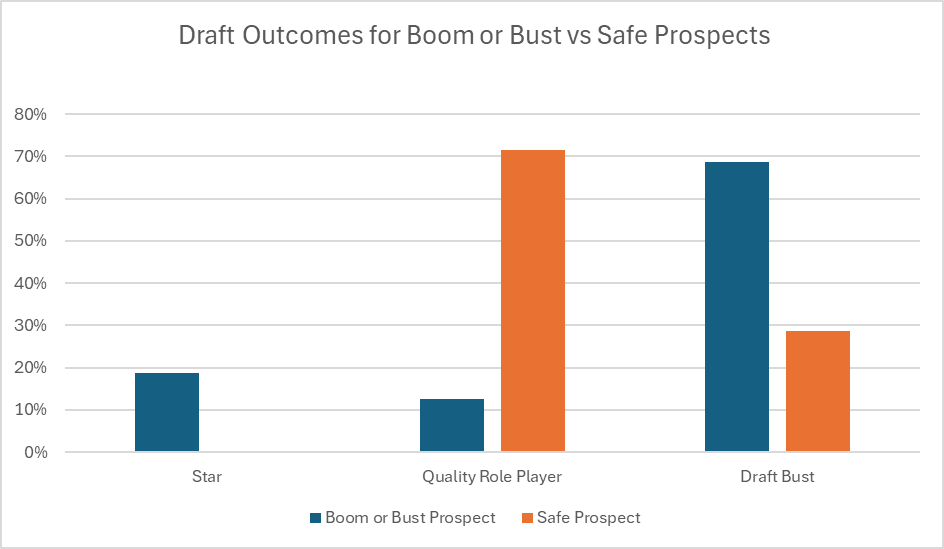
The results sent a clear message: the best way to get value in the middle of the first round is to take the safe prospect. While zero safe prospects in the data ended up as stars, 71% became quality role players, while only 29% busted. Quality role players included the likes of Donte DiVincenzo, Nickeil Alexander-Walker, and Jaime Jaquez Jr.
Meanwhile, boom-or-bust prospects were a very different story. 69% ended up as draft busts. 19% blossomed into stars, which were Bam Adebayo, Michael Porter Jr., and Alperen Sengun. Only 13% settled in the middle as quality role players. Even with two picks, the Hornets would be gambling with the possibility of getting nothing in this draft if they take two boom or bust swings.
In a world where cost-controlled role players create valuable salary cap flexibility, the Hornets would be wise to target the safer prospects in this year’s draft. A few particular names that stand out to me include Washington center Hannes Steinbach, Michigan forward Morez Johnson Jr., and Santa Clara forward Allen Graves.
Steinbach offers Charlotte a dominant rebounding presence after leading the nation in rebounds with 11.8 last season. Lacking physicality for years, the Hornets could use Steinbach’s brute force on the glass and would be a unique piece to add to the center rotation. Offensively, Steinbach is a tough matchup with his scoring ability. Notably, his ability to hit 3s would pair well in pick-and-pop situations with LaMelo Ball.
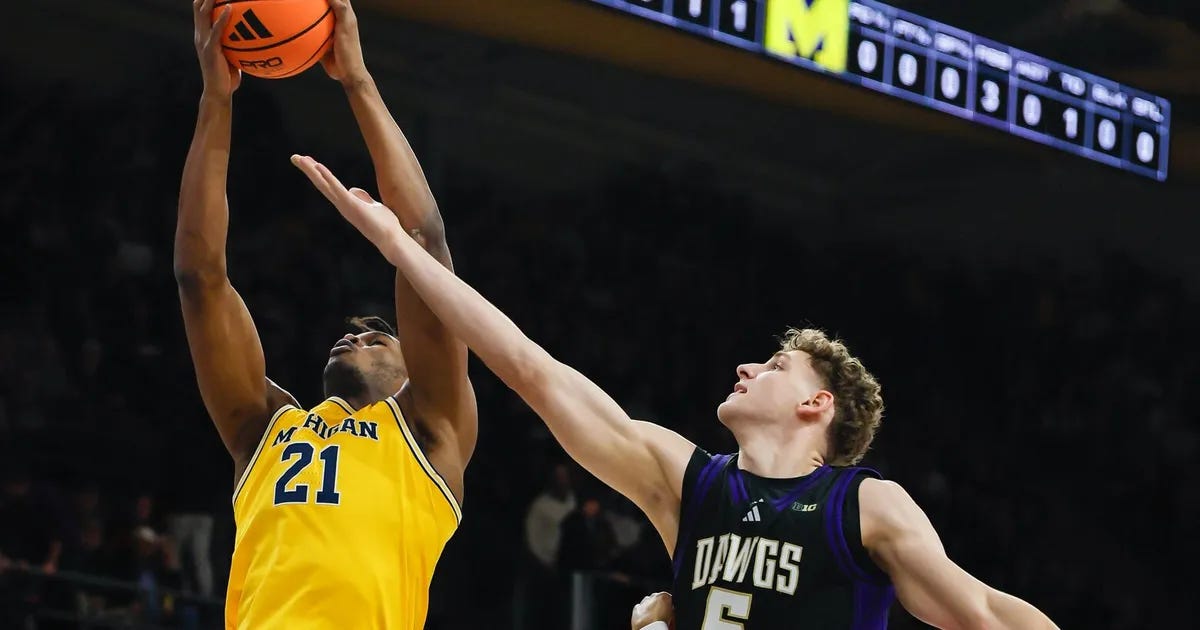
If the Hornets want to lean towards pure defense rather than rebounding, Johnson is the prospect for Charlotte. The national champion was a critical piece in Michigan’s defense this season as an athletic, high-octane defender. With a wingspan of seven-foot-three and a half, Johnson would instantly be one of Charlotte’s better defenders. Since both Miles Bridges and Moussa Diabate are entering contract years, there’s a real possibility that Johnson could take over a starting role by 2027 as a defensive specialist.
While he’s often lower on draft boards than Steinbach or Johnson, Allen Graves fits the profile Charlotte could target. Last year at Santa Clara, Graves posted impressive shooting splits, hitting at 51.2% from the field and 41.3% from deep. After settling in as the Broncos’ sixth man last season, I could easily envision a similar role for Graves in Charlotte. While his athleticism limits his upside, Graves appears to be a safe bet to be an effective role player at the NBA level.
With multiple options available, Charlotte has the opportunity to build valuable depth in this class. Finding role players on rookie contracts may be exactly what the doctor orders for the Hornets to find their way back to the playoffs for the first time since 2016.