


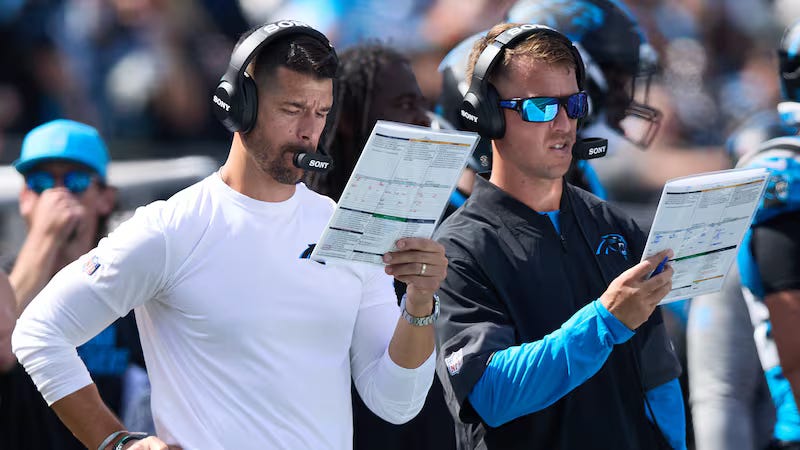
One doesn’t usually see a head coach give up playcalling duties in the offseason with seemingly little pressure to do so, but that’s exactly what Dave Canales publicly did in a pre-Combine press conference on Tuesday when he announced that he would be ceding playcalling duties to offensive coordinator Brad Idzik.
That’s not the only change the Panthers’ offensive staff has undergone in the past several days; Darrell Bevell has also joined the staff with the title of Associate Head Coach and Offensive Specialist (the Panthers haven’t officially announced Bevell’s hiring, but team press has alluded to it in this article about Canales’ decision).
Idzik has been Canales’ right-hand man since they were in Tampa Bay together, while Bevell was Canales’ superior when they both worked in Seattle – so neither of these moves really signals wholesale changes to what we can expect to see from the Panthers’ offense this fall. But they’re also not moves that a team and coach make if they don’t expect to see anything change.
While Canales’s stated reasoning was that playcalling was detracting from his ability to manage the whole game as a head coach, something does need to change with the offense. The vibes around the Panthers’ offense were better in 2025 than the previous year, thanks mostly to a couple of monster midseason games from the Carolina rushing attack and Tetairoa McMillan’s breakout season, and also the fact that the team scored enough to win 8 games, get into the playoffs and put up 31 points when they got there.
Statistically, however, they arguably regressed. The 2024 Panthers ranked 25th in the league in score percentage and 22nd in points per drive, while last season’s edition ranked 27th and 26th. Both squads ranked in the league’s bottom 7 in explosive play rate. The 2024 Panthers converted in the red zone much more frequently, 62% to 53.3%.
The numbers aren’t directly comparable because of how different the two seasons were for Carolina, but they still don’t paint a very flattering picture of the 2025 offense. If this team is to take another step forward and become capable of winning a couple of playoff games, Idzik will have to take this offense from “good enough” to just plain good. How he might go about doing so is a bit of a mystery, as he has just about no history of calling plays at any level of football.
Idzik isn’t bringing a new playbook, but he can differentiate himself in the way he sequences plays, approaches high-leverage situations, and the level of aggression he brings. And we do actually have some information on what he might be bringing in those aspects.
The Preseason Games
Idzik’s only documented experience of calling plays for a football offense comes from a few Panthers preseason games from the past two years. Idzik called plays in the second half of preseason matchups with the New York Jets and Buffalo Bills in 2024 as well as for the Panthers’ exhibitions against the Cleveland Browns and Houston Texans in 2025.
After the Cleveland game, Canales told reporters, “[Brad] kind of worked through a flow, worked through the openers, the first 15, so he kind of had his good amount of plays right there, the situational stuff, and I kind of was just in his ear with just the place, the style of plays that we were running,” or, in other words, that Idzik had the most control over the “first 15” and in particular situational calls, presumably red zone, short-yardage, and the like, while calls elsewhere were more up to what the Panthers’ decision-makers wanted to see in their evaluation process.
This means that we can glean from these games a little bit about his situational acumen and sequencing even though they were preseason games with little rhyme or rhythm to the game script.
One of the situations I think is illuminating in playcaller evaluation is how a playcaller treats second and short. Canales raised some eyebrows after a loss to the Patriots when he called second-and-short “an opportunity to run the ball” rather than a chance to be explosive, knowing you have one to two chances to get the yardage anyways.
It was a frustrating moment for a lot of fans, and it was at odds with the fact that the Panthers ended up as the team with the 2nd-most 4th down conversion attempts in the league – a team that willing (and able, given that the Panthers were 3rd in 4th down conversion rate) to go for it on 4th should be similarly willing to let it fly on 2nd.
Curiously, Josh Parasar at Paraball Notes has found that the numbers suggest that while 2nd and 1 specifically is a great passing down, the same isn’t really true of 2nd and 2-4. Anybody can get 1 yard when they need it, I suppose, but getting more against a short-yardage defense is not an automatic proposition.
Against the Browns, I saw Idzik strike this very balance. On two opportunities on 2nd and 1, he called pass plays and let his quarterbacks attack downfield, but on a couple of slightly longer second downs, the Panthers handed the ball off. Especially given the personnel deficiency the Panthers were working with as both teams’ reserves came in, this was an impressive bit of situational aptitude.
Less sterling was Idzik’s attempt at a two-minute drill to end the first half of that game. It was somewhat hampered by execution, but with 30 seconds and 3 timeouts to try and find about 45 yards for a potential field goal attempt, Idzik did not put his team in good situations.
On first down, a run surprised nobody and wasted a timeout while gaining just two yards. On second and third down pass plays, too many receivers ran to the short middle area of the field, which simultaneously bled time and crowded the area so that after-catch opportunities were limited. The Panthers went 3 and out, and it wasn’t just because backups were playing.
I suspect that 2-minute is an easier thing to learn than particular down-and-distance tendencies, so I think what I saw from preseason action is more encouraging than anything else – but there will probably be some growing pains that feel like elementary mistakes.
The Bevell Factor
Canales knows Darrell Bevell from their shared time in Seattle with Russell Wilson, but when he talked about the hire on Tuesday, he focused on Bevell’s most recent stop as quarterbacks coach and passing game coordinator in Miami under Mike McDaniel and working with Tua Tagovailoa, in an offense that has been among the league’s most explosive as long as Bevell was there (even in a down 2025, they ranked 10th in explosive play rate).
Bevell has long been a coach who puts a lot in his quarterback’s hands, back to when Wilson was improvising his way to being the league’s best deep-ball passer in the mid-2010’s. On the flip side, many Panthers fans and media noted that Canales’ playcalling, especially earlier in the season, appeared to reflect an incomplete trust in Bryce Young to execute on shots downfield and to get yardage in chunks.
While we can’t make any judgments about Idzik on this scale, the fact that Bevell has been brought in to help with the transition and be a “sounding board” indicates that Canales wants Young to operate more like a Tagovailoa or Wilson than as a chain-mover. Young has shown the ability, ranking first in PFF’s Big-Time Throw Rate and Passing Grade on 20+ yard passes in 2025, but some combination of Canales’ playcalling and his own confidence and willingness to throw those passes meant that the Panthers still didn’t create enough explosives. It stands to reason that part of Idzik’s job will be to put Young in positions where he’s both more willing and more able to sling it downfield and make this offense easier and more effective.
Wrapping Up
It has been unclear the last two seasons what role Idzik has actually played in the Panthers’ offense. Canales called him his “primary architect” in this press conference, which seems to imply that his influence has most been felt in the Panthers’ most scripted situations: opening drives, two-minute drills, and the like.
But, if anything, the fact that Canales has ceded playcalling duties reflects that he sees that the offense needs some changes and that he’s not the one who can most effectively bring them. It seems pretty clear where those improvements can come, and Idzik has already, in preseason action and through the influence he apparently has had on the Panthers’ success on opening and game-winning drives, shown some ability to affect exactly those marks – it’s no sure thing, but there does appear to be a direction with this move.
It’s audacious and a bit mysterious, but one also can’t really help but to root for a move that required this level of ego-shelving. Maybe some of these predictions are rooted in projection and expectation more so than observation, but as I said in the opening, this isn’t a move Canales makes if he doesn’t expect to see change result from it.