


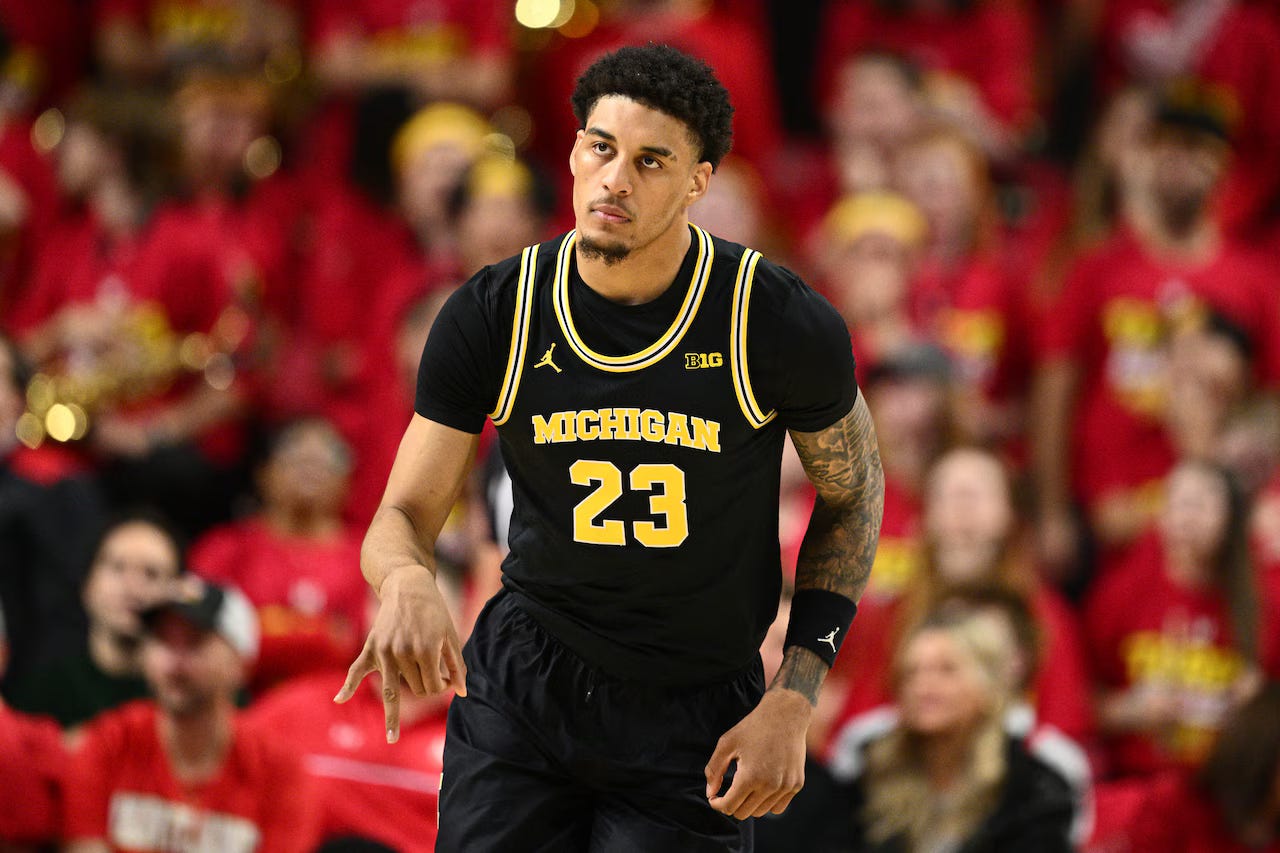
The Charlotte Hornets hold two top-20 picks, and among the most mocked players to the 14th pick specifically is Michigan forward Yaxel Lendeborg.
Lendeborg will be a case study for NBA teams moving forward. He will be 23.7 years old on draft night, is a noted late-bloomer when it comes to basketball, and improved significantly in each of his three division-I college basketball seasons.
The landscape of college basketball has changed in a way that’s advantageous for players. They can now make money on their name, image, and likeness despite playing in the NCAA.
This has changed the way players approach making the decision to go to the NBA. Draft classes as a whole are getting older as more players that would typically declare for the draft are heading staying at school for additional years.
Lendeborg himself would have been a top-40 pick had he declared for the 2025 NBA Draft.
Instead, he transferred from UAB to Michigan an won National Player of the Year, a National Championship, and helped drive his stock from that top-40 projection all the way into the lottery.
But along with taking a player like Lendeborg comes the notion of him being “pro-ready”.
And it’s a thought that isn’t without merit. Common sense says that players who are older when they are drafted should transition easier to the NBA game. They’re more physically and mentally matured, and should be able to step in as role players right away.
But is that actually true for these super-seniors? Are most of them actually “ready-made” role players? Or is the line a bit more blurred?
I dove into all of the players drafted top-20 since 2010 that were at least 23.0 years old on draft night, and whether they impacted winning from their first year in the league.
Dalton Knecht, Los Angeles Lakers
Rookie Season Stats: 78 GP | 19 MIN | 9 P | 3 R | 1 A | BPM -1.8 | 46/37/76 splits
Dalton Knecht was the 17th pick in the 2024 NBA Draft, and he averaged nearly 22 points per game in his final college basketball season at Tennessee on 46/40/77 shooting splits.
The status of Knecht’s age was a big pre-draft discussion. He played at a junior college prior to his time at Northern Colorado, then transferred to Tennessee for his final college season.
Knecht had more lagged development than anything else. He made a big leap in his junior year at Northern Colorado, but was a fairly insignificant role player before that.
Knecht, a 6-foot-6 wing, was viewed as a ready-made role player that can space the floor and make open shots.
“Knecht is as NBA-ready as any player in this class and he lands with a team that is looking to win now. He’s a three-level scorer and excellent 3-point shooter who will make a killing on catch-and-shoot opportunities playing off of LeBron James and Anthony Davis.”
And as a rookie, there were some flashes of that. Knecht had some occasional scoring outbursts, but his overall impact was inconsistent at best.
By the time the playoffs rolled around, Knecht was not a rotational player in the Lakers’ lone series against the Minnesota Timberwolves.
Part of this was likely due to some weird circumstances around his rookie season, he was traded to Charlotte as part of a package for Mark Williams before Los Angeles pulled the plug on the deal.
Still, the Lakers didn’t get the early impact they wanted (and was sold) from Knecht.
Verdict: Was not “NBA Ready” and is a borderline roster player in 2026-27.
Tristan da Silva, Orlando Magic
Rookie Season Stats: 74 GP | 22 MIN | 7 P | 3 R | 2 A | BPM -2.6 | 41/34/87 splits
Taken one spot after Dalton Knecht in the 2024 draft was Tristan da Silva, a forward out of Colorado.
da Silva averaged 16 points and five rebounds per game in his final college season at Colorado, earning All-PAC-12 Honors (RIP) in each of his final two years. And though da Silva’s path leading up to his college career was untraditional, he was someone who continually got better throughout his pre-NBA years coming up through Germany’s basketball roots.
“He can handle the ball well for his size, make simple reads as a passer and defend multiple positions… da Silva is right in line with Orlando’s expedited timeline.”
The immediate returns from da Silva’s rookie season were a bit lackluster. He didn’t receive any All-Rookie First Team votes and was out of the rotation by the time the Magic played the Boston Celtics in their first-round series.
Still, da Silva has shown more growth since then, and the Magic seemingly hit on him as a rotational forward.
While I’ll say that da Silva wasn’t an immediate contributor, he does project well as a 6th-8th man moving forward.
Verdict: Will be a good role player, but wasn’t “NBA-ready”
Chris Duarte, Indiana Pacers
Rookie Season Stats: 55 GP | 28 MIN | 13 P | 4 R | 2 A | BPM -2.3 | 43/37/80 splits
Chris Duarte’s rookie season is one of the more interesting case studies. He’s one of the oldest lottery picks (13th overall) since 2010 at 24 years old, with a lot of his pre-draft appeal coming because he was a ready-made floor spacer.
Duarte grew up in the Dominican Republic before moving to the United States but wasn’t a major recruit, ending up at a junior college before transferring to Oregon for his final two college seasons.
Duarte averaged 17 points, 5 rebounds, and 3 assists on 53/42/81 shooting during his final year at Oregon.
Here’s an excerpt from an article of when the Pacers took Duarte:
“At 24 years old, Duarte is one of the most NBA-ready players in this year's class. Unlike some of the younger and more raw prospects in the draft, the Dominican Republic native should be able to contribute right away for the Pacers”
Duarte’s rookie season was a weird one. He started out red-hot, scoring 27 points in his NBA debut against the Charlotte Hornets.
Duarte was fairly consistent throughout his first year in the NBA. He was marred by some injuries late, but he’s one of the few players on this list that actually finished on an All-Rookie team (though he did not receive any All-Rookie 1st Team votes).
And though he saw some early success, Indiana probably regrets picking Duarte as high as they did. He played four NBA seasons before exiting the league. Just four years after being picked, he’s playing in Liga ACB (Spain).
Verdict: Duarte was one of the bright spots for a 25-win Pacers teams, but only declined from there.
Cam Johnson
Rookie Season Stats: 57 GP | 22 MIN | 9 P | 3 R | 1 A | BPM 0.3 | 44/39/81 splits
Cam Johnson is one of the best players on this list. He was billed as a ready-made shooter coming out of the draft, expected to be picked in the later-half of the 2019 first round.
Instead, the Suns took him 10th to everyone’s surprise (including his college teammate Coby White).
Johnson spent five years in the ACC, with his play jumping in his final college year. He averaged 17 points per game on 46% shooting - a really good number for a 6-foot-9 forward.
Here’s an analysis of Johnson’s readiness from when he was picked by the Suns:
“Johnson will improve the Suns’ floor-spacing considerably and will be able to get on the court right away, but it remains to be seen whether the Suns actually needed to pull the trigger at No. 11 to get him or could have gotten him later, even all the way down at No. 32, the pick they gave up to move off of Warren’s salary.”
Johnson had a good rookie season. He didn’t make an All-Rookie team, but he was a solid bench contributor for a middle-of-the-pack Suns team.
He is the most valuable player on this list, and currently still making an impact for the Denver Nuggets.
Verdict: Cam Johnson was, in fact, an NBA-ready player that continued to grow throughout his time in the NBA.
Buddy Hield, New Orleans Pelicans
Buddy Hield is the “NBA-ready” player of all time. He was 23.5 years old on draft night before being selected with the 6th overall pick by the New Orleans Pelicans.
Hield won the Naismith National Player of the Year in his final season at Oklahoma, when he averaged 25 points, six rebounds, and two assists per game on 50/46/88 shooting splits - just ridiculous numbers for a player at the college level, even considering his age.
Hield stayed a full four years at college, growing throughout his time at Oklahoma. He grew up in the Bahamas which lagged his age by about a year in terms of making it to the collegiate game. Hield was later to entering high school in the United States, though he eventually proved himself as a high-end recruit.
A pre-draft profile of Hield read:
“His age and lack of defensive ability will give teams pause, but he will provide an NBA-ready skill to whatever team selects him in the top 10.”
Hield’s rookie season was a weird one, though.
After 57 games with the New Orleans Pelicans, he was traded to Sacramento as part of a package for Demarcus Cousins.
In the games for New Orleans, he averaged just under nine points on 39/37/89 shooting splits - that’s not great.
The Pelicans were a middle-of-the-road team in the Western Conference with playoff aspirations (hence the bigger trade).
Upon arriving to the Kings, Hield was significantly better. He averaged over 15 points per game on 43% from three.
Still, the Kings finished with 32 wins, and Hield’s stretch of play prior to the trade is enough for me to deem that he wasn’t quite as NBA-ready as billed, especially being the 6th overall pick.
Hield has since turned into a quality bench scorer, though he isn’t the starter many hoped he’d be.
Verdict: Not NBA ready, but has turned in a solid career.
Delon Wright, Toronto Raptors
Rookie Season Stats: 27 GP | 9 MIN | 4 P | 1 R | 1 A | BPM 0.9 | 45/39/74 splits
Delon Wright had some academic issues in his senior year of his high school, which delayed his path to college basketball. Eventually, he found himself at Utah, where he averaged 15 points, 6 rebounds, and 5 assists throughout his two college seasons.
Wright, being an older prospect, found himself with the “NBA Ready” label attached. He was an older prospect, though was one who started his basketball career early, it just wasn’t able to continue as most players.
“In Delon Wright, the Toronto Raptors landed a backup point guard who can contribute right away.”
The Raptors would need that type of impact, too, given they were interested in making it far into the postseason.
Wright’s rookie year was fine for a 20th overall pick. He didn’t contribute much, despite that pre-draft billing, and was efficient and effective in the minutes he did play.
Still, I don’t think I would qualify him as “NBA ready” by any stretch. He didn’t see any a rotational role in the playoffs, and was only minimally involved in the Raptors’ season.
Verdict: Delon Wright was not an “NBA-ready” prospect.
Adreian Payne, Atlanta Hawks
Rookie Season Stats: 32 GP | 23 MIN | 7 P | 5 R | 1 A | 41/11/65 splits
Adreian Payne was a classic late-breakout at Michigan State. Prior to his senior year of college, Payne averaged seven points and five rebounds per game.
He was genuinely special in his senior season, though, where his scoring bumped up to 17 points per game, with Payne making 42% of his 3-pointers, as well.
The DraftExpress profile paints a pretty good picture of how NBA teams viewed Payne:
“While Payne is very much a known commodity and in some ways could be considered a finished product at age 23, there's a comfort level in what he brings to the table and how easily he can be plugged into a NBA role”
Payne would only end up playing four total seasons in the NBA, a total of 107 games.
I don’t want to pile on here, but there just wasn’t much for Payne at the NBA level. It just didn’t work.
Verdict: Payne was neither an “NBA ready player” nor someone that grew into being a long-term contributor.
Ekpe Udoh, Golden State Warriors
Rookie Season Stats: 58 GP | 18 MIN | 4 P | 3 R | 1 A | BPM -3.8 | 44/0/66 splits
Udoh’s path is arguably the most similar to Yaxel Lendeborg, if you had to make me pick. He was late to basketball, developing later in his college years after coming to the United States from Nigeria.
Despite his older age, he was viewed as developmentally young, which helped sell the Warriors on using a top-10 pick on him. Udoh’s combination of floor and developmental ceiling separated him more than other older prospects - and is arguably the most intriguing older player profile prior to Yaxel Lendeborg.
Udoh averaged 14 points and 10 rebounds (along with 3.7 blocks) per game.
A big with his skill level was already intriguing to NBA teams:
“It’s Udoh’s work ethic at the offensive end that has made him a weapon all over the floor and has propelled him up NBA draft boards. He uses a nifty jump hook in the lane and is effective with his back to the basket or facing it. He can step out and bury the midrange jumper and even, as Kansas’ coach Bill Self said, can hit a 3-pointer. He’s made 5 of 14 this season.
He has also developed excellent ballhandling skills, allowing him to take his man off the dribble and create for himself, a rare quality for a big man. He’s gone to the free throw line a team-high 87 times.”
So it’s easy to see why the Warriors were sold on him so early in the 2010 draft (funnily enough in between the team’s selections of Steph Curry and Klay Thompson).
Still, Udoh didn’t quite translate to the NBA.
He averaged only 18 minutes per game as a rookie, didn’t garner any All-Rookie 1st Team votes, and became a journeyman relatively quickly through his career, despite hanging around the NBA as a depth big for the better part of a decade.
Verdict: Udoh was not “NBA-ready” nor was he a long-term rotation piece.
So what does all of this mean in relation to Yaxel Lendeborg?
Yaxel Lendeborg’s profile matches these types of players more than others. He rarely played basketball early in his life, and was even deemed academically ineligible to play at one point.
He generated enough buzz to make it to a junior college, worked his way up to Division-I college basketball at UAB, and then transferred to Michigan for his final college season. Nothing about his background is common for NBA prospects.
But we have seen older prospects with unorthodox paths make it to the NBA with the same “safe, NBA-ready” billing before. It hasn’t always worked out.
I think the point of this article is to establish that these older players aren’t as known commodities as we’d like to believe.
Even if you lower the 23.0 year old threshold to just 22.5 years old (in addition to being top-20 picks since 2010), the players we’re adding to the existing list are: Davion Mitchell, Denzel Valentine, Jarian Grant, Doug McDermott, Andrew Nicholson, and Wesley Johnson.
Again, just not the best crop of talent. You’d expect there to be more decent role players, if not solid starters.
Lendeborg is arguably the best “prospect” we’ve discussed today. He’s a lengthy forward with a ton of NBA-level skills. But that doesn’t necessarily save him from having a similar floor to players such as Ekpe Udoh, Delon Wright, Dalton Knecht - all of which were talked about in similar fashion in their pre-draft cycles.
I’ll end with this: Drafting older players early doesn’t necessarily raise the expected floor of a pick, but it definitely lowers the ceiling.
Yaxel Lendeborg could absolutely break the trend here. He’s a prospect that we haven’t seen before. But I don’t think I can find myself betting on a historical age outlier.