


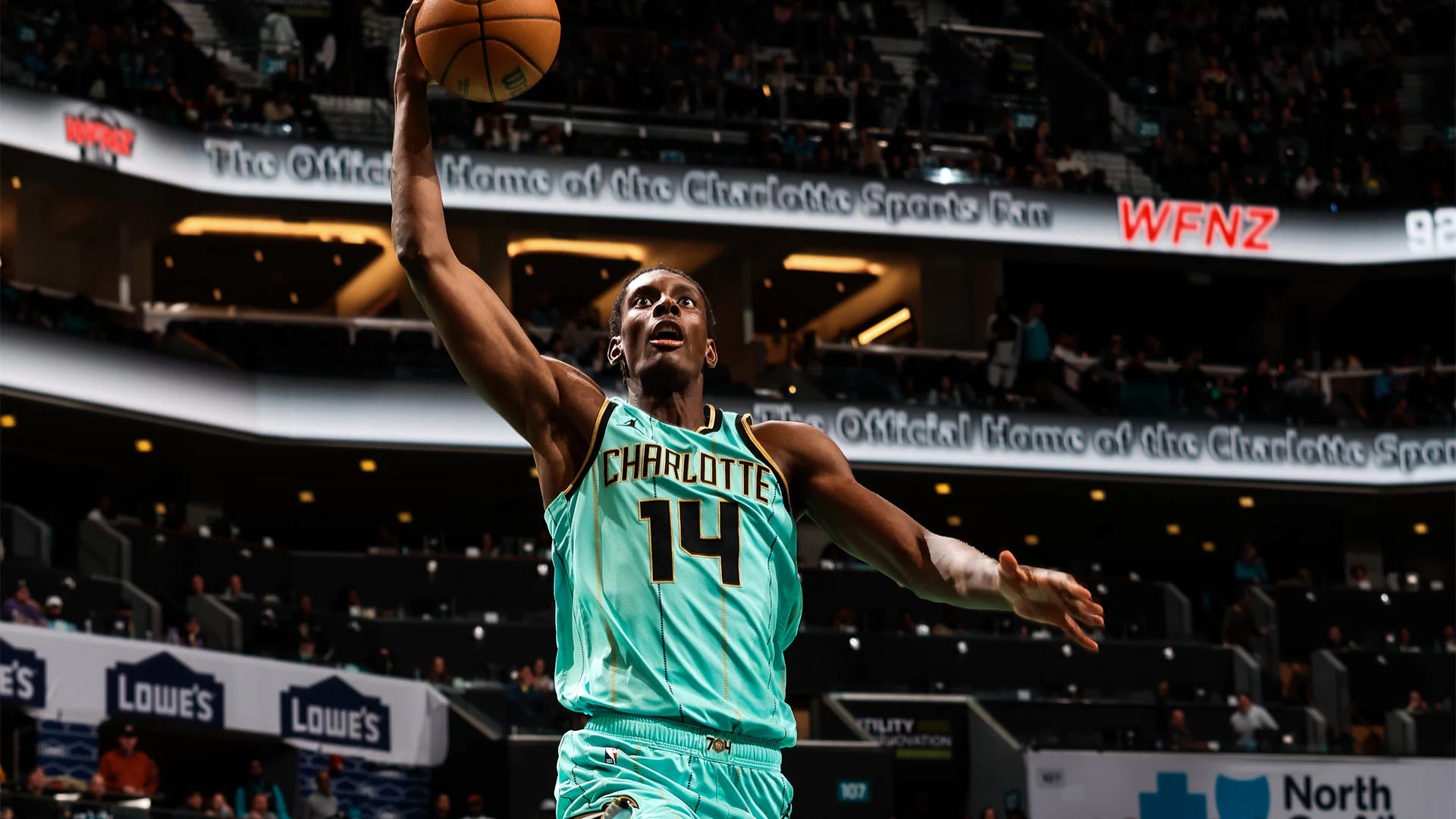
Moussa Diabaté’s impact won’t always show in the box score, but it is always there.
He molded his game around doing the little things, and it took him from being a two-way player searching for his second opportunity to one of the Hornets’ best developmental stories in recent history.
Diabaté’s willingness to embrace a role that many players can’t earned him recognition last season as the NBA’s Hustle Player of the Year. It’s an award unlike any other in the league, as it is not voted on but determined by a formula.
That formula includes stats such as box outs, screen assists and shot contests, all areas Diabaté finished near the top of the league in.
“Little things matter,” Diabaté said to a group of reporters, supporters and teammates as he was officially presented the award. “I feel like, as players, sometimes we kind of forget it, and we’re just looking at the stats.”
While the contributions Diabaté makes can often go unnoticed, he did them so well, so often, it was hard to miss.
The Moose Is Loose
Diabaté quickly became a fan-favorite last season. Antler-topped spectators began to fill the seats of the Spectrum Center, eagerly waiting for their moment to burst into one long, harmonized moose chant.
At Michigan, a younger Diabaté envisioned getting to the NBA and receiving that exact kind of fanfare. Four years and two stops into his career, he finally achieved it.
“My friend Will Tschetter is the one that brought it up, the whole Moose is loose and this whole thing,” Diabaté said. “ I just remember thinking one day I hope that would be dope. I get in the league, and whenever they call my name, you just have everybody saying my name … for it to finally happen, it’s dope.”
Selected with the 43rd pick in the second round, Diabaté was seen as a raw but physically gifted prospect, even if a bit undersized. There were questions about his offensive game, and he was considered a project player.
Diabaté played in 33 games in two seasons with the Clippers, never averaging over nine minutes per game. He spent 32 games with the team’s G-League affiliate and impressed there, averaging 16 points and 12 rebounds per game.
When the Clippers decided to give up on him, the Hornets and GM Jeff Peterson swarmed in.
”The thing that always attracted me to Moussa was just, again, his energy,” Peterson said. ”Gets drafted by the Clippers, things just happened. It didn’t work out or whatnot, and he was humble enough to accept a two-way contract with us. From the minute he stepped in the gym, we just knew that we could have a piece there.”
Diabaté’s first two years in Charlotte have gone about as well as one could hope.
He kept his head up and worked with head coach Charles Lee and the Hornets staff, earning an upgraded three-year deal with the team. His numbers have increased each season as he filled the starting center hole and done it well.
But most importantly, Diabaté does the dirty work for a team that has desperately needed it.
”It might not work out somewhere, but as long as you stay locked in, and you do what you’re supposed to do, things are going to get figured out,” Diabaté said.
No Points, No Problem
Diabaté can have a game where he scores zero points and still be one of the most important players on the floor.
When he firmly became the Hornets’ starting center in December, the team was (9-20) overall. Charlotte would go on to finish the year (35-18), for the sixth-best record in the NBA in that span.
A lot of that turnaround can be attributed to health and the team’s “big three” coming together. But a lot of it can also be attributed to Diabaté.
Of the nine stats that determined this year’s hustle winner, Diabaté finished in the top-11 for six of them. This includes first in offensive box outs, fourth in screen assists and eighth in offensive loose balls recovered.
If a shot went up or the ball wound up on the floor, teams were forced to throw bodies at Diabaté. If not, he’d somehow wind up with the ball and give the Hornets an extra possession.
“It’s definitely not easy,” Diabaté said. “ You might not score, you might not get all the rebounds that you want, but just know that if you keep on applying the same pressure every single time, it’s going to happen.”
He never worries about his own scoring, but that doesn’t mean he won’t shoot.
Diabaté averaged a career-best eight points per game on 63% shooting in 2025-26. Almost all of those shots came in front of the rim, and they were usually the result of his greater effort.
Numerous times, Diabaté got to the bucket by simply being the first guy down the floor. With a point guard like LaMelo Ball, that will get you easy looks.
As a screener, he got plenty of roll opportunities as the defense was forced to step up on the Hornets’ shooters. His work on the offensive glass gave him second-chance looks, even if more often than not, he’d pass up a putback attempt for a kick-out look.
That tenacious playstyle would usually leave players exhausted, but not Diabaté.
“I trust my conditioning, that’s something that I’m very proud of,” Diabaté said. “ I put a lot of emphasis on being the most conditioned player.”
Diabaté’s individual effort did not just elevate his game, but it became the foundation of the Hornets’ identity last season.
The Hornets used to be a team where you could question their will to win, but not anymore.
Charlotte worked as a collective unit, scoring the third-most points off screens, grabbing the fifth-most offensive rebounding and averaging the second-most second-chance points.
They might not have had the All-Star-level talent that other teams had, but their effort made the Hornets good enough to compete with anyone, and Diabaté was at the center of it.