


As explained in the current NBA Collective Bargaining Agreement (CBA), a Mid-Level Exception (MLE) is an exception to the salary cap which allows teams to sign and/or acquire one or more players.
There are three versions of the MLE under this latest CBA, “non-taxpayer”, “taxpayer”, and “room”. The non-taxpayer, which the Hornets are projected to have, is calculated as 9.12% of the salary cap.
According to Spotrac, the projected non-taxpaying MLE for the 2026-27 season is $15,049,000, which for this exercise we will just be calling $15M to keep things simple. This means the Hornets can use that $15M exception to either sign players or absorb player salary via trade.
The key player profile I think the Hornets may look to prioritize with their MLE is a real physical big-man to go alongside Moussa Diabate and Ryan Kalkbrenner. The Hornets’ lack of physicality was on display for all to see during their play-in loss to the Orlando Magic, and the MLE gives them a great opportunity to go out and acquire an experienced player fitting this archetype.
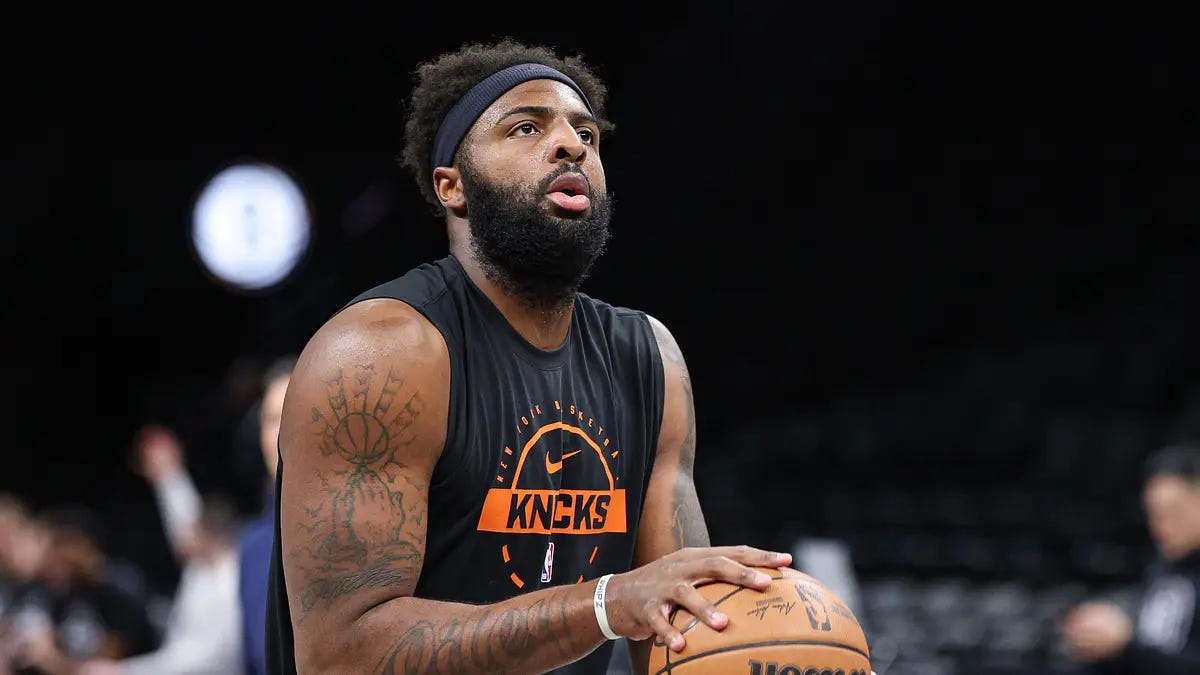
My top pair of free agent bigs for Charlotte in this class are Mitchell Robinson and Robert Williams III.
Mitchell Robinson, in particular, sits at the top of this list for me. The true 7-footer makes his money in the paint on the defensive end as an anchor, but is still viable offensively primarily through pick-and-rolls or dribble hand-offs.
However, the key skill I highlight for Robinson on the Hornets is his elite offensive rebounding. It’s no secret that he is one of the league’s best offensive rebounders. Robinson is grabbing 10.6 offensive boards per 100 possessions this season.
He has consistently, over the last four seasons, ranked in the top percentile for offensive rebound rate off a team miss, with his tally for this past season beating every other player with an insane 21.1%.
To put this into perspective, Moussa Diabate’s number for the same metric is 14.7%.
Stylistically, he’s different from Diabate, where each can feature depending on the in-game needs/matchup without ever having to sacrifice the elite offensive rebounding which was such a distinctive feature of head coach Charles Lee’s system last year.
Robert Williams III makes for a nice alternative option - offering a different type of game. He doesn’t quite hold up to the top percentile offensive rebounding standards of Mitchell Robinson or Moussa Diabate. I mean he’s no slouch, but his two-way paint presence where he shines which he is arguably more impactful in than that of the other two.
Whilst Williams may seem like a slightly undersized big-man, standing at roughly 6-foot-9, his huge 7-foot-5 wingspan helps him play above his height. He masterfully makes use of this wingspan on both ends of the court.
On the defensive side he is a real deterrent in the paint with fantastic shot blocking ability. His wingspan is his biggest friend here, as he utilises it to get his fingertips to intercept lob attempts, or swat shots away.
The highlight of his defensive game is how efficiently he blocks shots.
Williams times his contests extremely well and is very disciplined, holding the league’s second best block to foul ratio at roughly 1.2 blocks/foul. The only player above him in this category is Victor Wemanyama (1.3 blocks/foul). They are the only two players in the league with a positive ratio in this statistic.
Offensively he is an efficient above the rim finisher, holding a true-shooting rate of 72% this past season. This could make him a nice fit next to LaMelo Ball in a potential pick-and-roll, with his legit lob-threat adding another tool to the offense.
Just like Robinson, the man they call “Time Lord” also would bring deep playoff experience to this young Hornets team. He was a staple on the Celtics team from 2021-2023 which reached the eastern conference finals in back-to-back years before he was traded.
Two big forwards that can shoot it in Rui Hachimura and John Collins could also be on the radar for those making moves in Queen City. Whilst both featured heavily for their respective Los Angeles franchises, there is a chance that either could be let to walk this off-season.
Rui Hachimura, the 6-foot-8, 230 lb forward has been utilised as a stretch four in LA where, he has been a real sniper.
As a Laker, across 228 games, he has shot 42% from beyond the arc on 3.6 attempts per night.
Hachimura notably rose to the occasion these past playoffs, where his percentage shot up to 57% on nearly 6 attempts per game.
It is no secret how important three-point shooting is to this team, and a player that’s proven he can do that amidst the highest level of competition is not someone you can write off as a Hornets target. One question that remains is whether the Lakers will let him walk into free agency as they did with Dorian Finney-Smith just one year ago.
John Collins, on the other hand, has had some blips, but for the most part he has been a steady three-point shooter since arriving in the league out of Wake Forest.
Collins had a similar statistical shooting year to Hachimura last year, he shot just over 40% on a similar number of attempts.
However, he is a much more versatile scorer. He attempts twice as many shots at the rim as Hachimura and does so at an incredibly efficient rate of 75% - a number more comparable to Robinson and Williams (72% & 78%). He is able to achieve such a number through his dunking ability both off the dribble and finishing plays.
Outside of Miles Bridges, there weren’t really any guys who could drive to the rim in Charlotte last year, and it showed as the team finished ranked 23rd in both rim shot frequency and rim scoring efficiency. Going into next year with playoff aspirations, the Hornets should look to diversify their scoring just a tad, and John Collins can help achieve that.
Despite these various options, ultimately I think the key decider around how the Hornets utilize their MLE is how the coming NBA draft plays out.
I think the MLE is most likely to be used to plug the gap(s) Charlotte missed out on in the draft. For example, if the Hornets are to draft, say, a Morez Johnson Jr., would it then make sense to then go and acquire Robert Williams III?
Or if Santa Clara’s Allen Graves is picked up at pick 18 then is there then a need for a Rui Hachimura or John Collins?
The draft will narrow Charlotte’s targets down to slimmer pickings. Combining this with the fact that 24 other teams are projected to have access to the same MLE as the Hornets, all signs indicate it to be a very competitive market. I can foresee it being somewhat of a gold-rush where the NBA’s “food chain” will likely come into play.
Whilst the Hornets reputation is growing around the league these days thanks to the new ownership, it is still far from that of the Lakers, Celtics, or even now the Pacers (all of which have the MLE). Hence, the Hornets may unfortunately find they miss out on the player they desire.
Because of this it is worth noting there are some other names that wouldn’t be as expensive or sought after that could still offer something to the Hornets. 14-year NBA veteran Andre Drummond’s physicality and rebounding still earn him a place in the league. He showed his value these past playoffs playing 15 minutes a night for the 76ers in their victorious 7-game series against the Celtics in the first round. His rebounding expertise and experience can be of value to the Hornets.
Dean Wade is another name in this field. The man who’s spent all his 7 years in the league on the Cleveland Cavaliers may be looking for a new home this off-season. He plays as a 3&D forward and has been a solid connective piece in playoff runs for Cleveland during his tenure. I think the Hornets could appreciate his combination of three-point shooting, size, and switchability on defense.
However, if it’s not one of the premium free-agent options the Hornets may not be interested. But that does not mean the MLE cannot be of use. As long as the incoming contract(s) doesn’t take the team over the first apron, the MLE can be utilised to bring in additional salary via a trade.
This could be of use for the Hornets as a way of maneuvering around the forthcoming roster size issues.
For this reason the only real option I see the Hornets attaching the MLE too in a trade (besides a shock blockbuster move) is Tre Mann in just a straight up player-for-player trade. His contract aggregated with the MLE would allow the Hornets to bring in a contract worth up to $23m. Attach maybe a 2nd round pick or two and it can make for a respectable package.
If the Hornets feel they need another guard post-draft then there are guys like Malik Monk or Dennis Schroder in that range. Both the Kings and Cavaliers are both above the first apron so they could be in the market for downsizing contracts and this is something the Hornets can play on.
There aren’t really any attractive or realistic wing/forward options (unless OKC wants to shed some salary by moving players like Isaiah Joe or Aaron Wiggins). Bigger guys like Daniel Gafford, Bobby Portis, and Steven Adams however all could be of interest. But if the Hornets move for these guys they would have to attach some kind of capital as a sweetener as none of their teams need to desperately downsize in salary.