


The Carolina Panthers are back. After a grueling seven seasons, the Panthers did the unthinkable, winning the NFC South for the first time since 2015 and hosting a home playoff game. Just listen to that crowd pop on Jalen Coker’s go-ahead score.

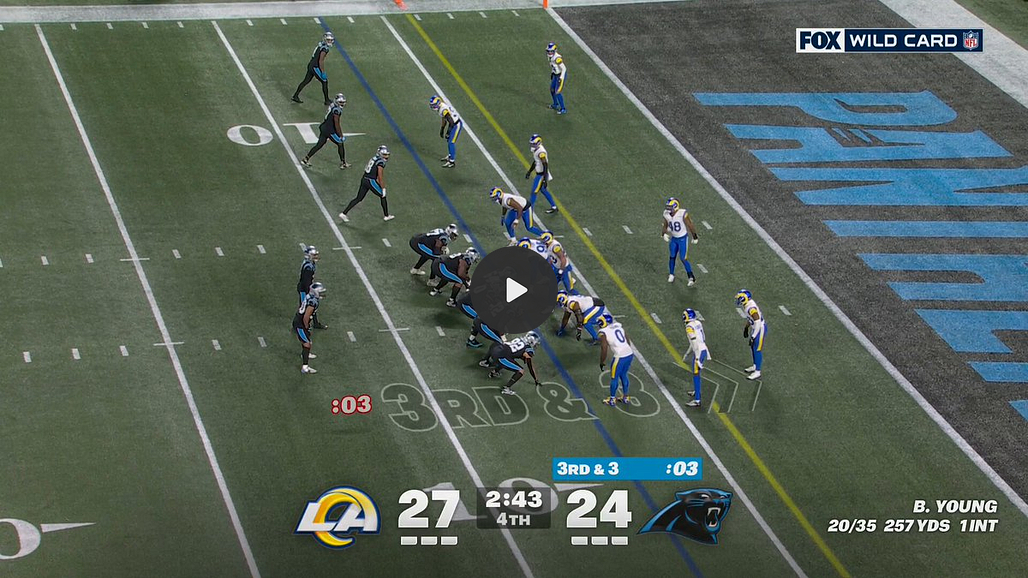
Although the outcome wasn’t what fans wanted, appearing in the playoffs (and putting up a good fight against the eventual MVP) is a significant step for a team that has spent the last half-decade in the gutter of the NFL.
So what’s next? In order to build off of a season of overachieving, GM Dan Morgan and his staff must continue to improve their roster. While the NFL Draft commands the eyes of NFL fans in the spring, free agency takes place even sooner.
By the time this article hits the airwaves, it will be less than two weeks before teams can begin negotiating with free agents. While the League New Year is officially 4pm EST on March 11, the “legal tampering” window, where teams can agree to terms with free agents, will begin at noon on March 9.
Before diving into exactly which free agents Carolina can target, it’s important to understand both current and potential cap figures for the team.
How We Got Here
As it currently stands (Feb. 25), the Panthers have $12,574,504 in 2026 cap space, good for 18th in the NFL according to OverTheCap. This number is sure to fluctuate over the coming weeks, but for now, Carolina doesn’t have a lot of spending room.
For a team that’s been at the bottom of the league for half a decade, you might expect a lot more cap space. However, poor decisions from the previous regime has largely mired the Panthers’ ability to be big spenders.
While free agency comes first on the NFL calendar, long-term team-building begins with the NFL Draft. Draft selections bring young, talented, cost-controlled players that allow teams to build their depth over time.
In the four NFL Drafts that predate Dan Morgan’s promotion to General Manager (2020-2023), the Panthers made a total of 29 selections. Of those 29, only seven remain on the current roster, four of which are top ten selections: picks you are expected to hit.
When a team is unable to build via the draft, they have to rely upon free agency to supplement to the missing depth, and in the Panthers’ case, starters. Talent will always be more expensive at the veteran level compared to collectively-bargained rookie-scaled contracts.
The poor drafts and subsequent overpays have created a cycle in which the Panthers had to constantly extend and restructure contracts to make spending room.
However bad the cap moves may have been in the early 2020’s, Dan Morgan and Vice President of Football Operations Brandt Tilis have positioned the team in a good spot moving forward, and can even create more space this season without compromising the future.

Potential Cap Outlook
Carolina’s Morgan/Tilis brain trust has been very deliberate in their first two offseasons; never pushing more money down the road than they have had to. A large part of the team’s success has been because of this flexibility.
Now, however, the process may see a bit of a change.
Winning the NFC South and hosting a playoff game could signal a shift in the timeline. No longer should the Panthers be looking to sign free agents just to field an NFL roster. Rather, this team should be looking to compete in the postseason.
In order to have postseason aspirations, the Panthers need high-level talent. Acquisition of said talent can come from the draft, via trades, or in free agency. Whichever avenue(s) Carolina intends to explore, they will ultimately need more cap space.
There are many methods a team can employ to create space, but teams mainly use cuts and restructures to add financial flexibility.
A cut is simple - you release the player from the roster in exchange for cap space. Cutting a player will often result in dead cap space, a cap charge resulting from guaranteed money already paid. In the grand scheme, however, dead cap is a sunk cost - you’ll have to pay this charge anyway, so it shouldn’t stop Carolina from creating more space in the short and long terms.
Restructures are a bit more complex. There are many different ways to restructure a player’s contract, from including the movement of guaranteed money, to adding bonuses, to signing a contract extension which can change a contract’s hit on the salary cap.
The simplest restructure is aptly known as a simple restructure: pushing money into future years on the player’s contract. Repetition of this can create long-term problems for undisciplined teams, but restructuring star player contracts is generally fine in moderation.
With these methods in mind, Carolina has a reasonable path to having mush more wiggle room in free agency. Restructuring defensive stars Derrick Brown and Jaycee Horn adds close to $24 million in cap space.
Cutting players in the last year of their respective deals, such as defensive tackle A’Shawn Robinson and tight end Tommy Tremble also yields around $16.5 million in cap space.
Both players impact the game in positive ways, but could be reasonable cuts given their pending free agency next offseason.
Carolina’s staff could go crazy with the cuts and restructures, ultimately creating upwards of $70 million worth of cap space, though it’s hard to envision them being reckless. Somewhere between $25-50 million is likely where the Panthers will end up over the next few weeks.
Panthers Free Agency Plan
In the two offseasons Dan Morgan has been at the helm, there has been a deliberate plan in free agency.
First, in 2024, Carolina dished out big money for guards Robert Hunt (5 years, $100 million) and Damien Lewis (4 years, $53 million) in an attempt to fix the offensive line woes. Both guards have provided immense returns, helping stabilize the interior offensive line for quarterback Bryce Young.
Last offseason, the Panthers shelled out on the defensive side of the ball, adding defensive tackles Tershawn Wharton (3 years, $45.05 million) and Bobby Brown III (3 years, $21 million), as well as star safety Tre’von Moehrig (3 years, $51 million). These signings were part of an effort to fix the worst defense in NFL history.
With Morgan and his staff’s persistence in adding to both sides of the trenches, it makes sense that they would continue to attack the offensive and defensive lines.
Left tackle Ickey Ekwonu’s injury could prompt a short term investment at that position. Competent blindside protectors rarely hit free agency, but with San Francisco and Trent Williams at an impasse, the star left tackle could become a good, albeit costly stopgap.
On the other side of the ball, edge rusher has not been a place where the Panthers have spent big in free agency. Former first rounders Odafe Oweh, Jaelan Phillips, and Bradley Chubb all would provide immediate upticks in sack production - a spot Carolina ranked tied for 30th in the league.
Inside linebacker is the other key spot the Panthers have been linked to during the offseason. Throughout the franchise’s history, ILB has been a legacy position.
From Sam Mills beginning the Keep Pounding mantra, to Dan Morgan himself as a Pro Bowl player, to recent Pro Football Hall of Fame Inductee Luke Kuechly, linebacker has been the through line for Panthers football.

In recent years, the team hasn’t had a standout player at the position. If he isn’t placed on the franchise tag, Jaguar’s Devin Lloyd makes a lot of sense as a star in the middle of the defense. After a breakout season, Lloyd will certainly be commanding a heavy contract in a few weeks.
While there may not be a lot of star power in free agency this year, there are many serviceable linebackers Carolina could attempt to sign. Cheaper options than Lloyd could include players like Leo Chenal, Nakobe Dean, Quay Walker, or former Falcon Kaden Elliss.
Although potential external additions will gain a lot of attention, the Panthers have a few internal free agents that make sense to bring back.
Offensive linemen Yosh Nijman, Cade Mays, and Brady Christensen all make sense to keep for continuity and depth purposes. Mays will likely be the most expensive to retain, but his connection with Bryce Young might force Carolina to keep him in house.
On defense, starters Christian Rozeboom and Nick Scott are set to hit the open market. It makes sense to try to upgrade at their positions (linebacker, safety), but continuity and communication on defense may prompt Carolina to bring them back.
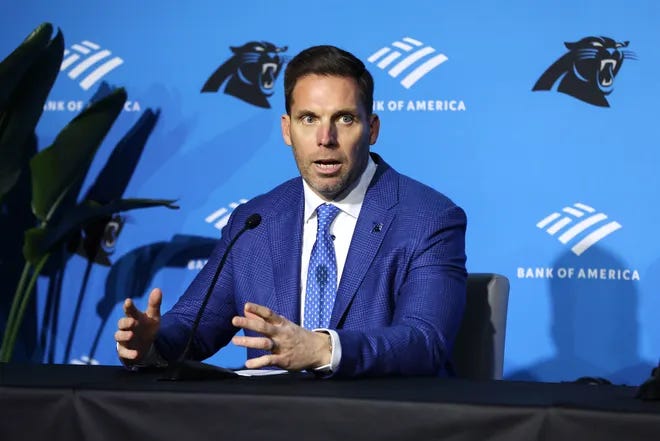
Free agency will be upon the Panthers in less than two weeks. Given Dan Morgan’s comments during his media availability at the NFL Combine, I’d imagine Carolina will be willing to be aggressive in adding to areas of need.
With a plan in place and the goal of winning the NFC South for a second consecutive season, fans should prepare themselves for at least a few free agent fireworks.