


The NBA Draft is less than two months away, and lottery night is in a week. The Hornets have a 97.6% chance of remaining at the 14th overall pick. And while I’m not ruling out the possibility of that other 2.4%, I think it’s safe enough to talk as though Charlotte will hold picks 14 and 18 in the 2026 NBA Draft.
In my draft research and prep in creating the 2026 Hornets Draft Guide, one name seems to float to the top of cultural zeitgeist of Charlotte Hornets fans - Caleb Wilson.
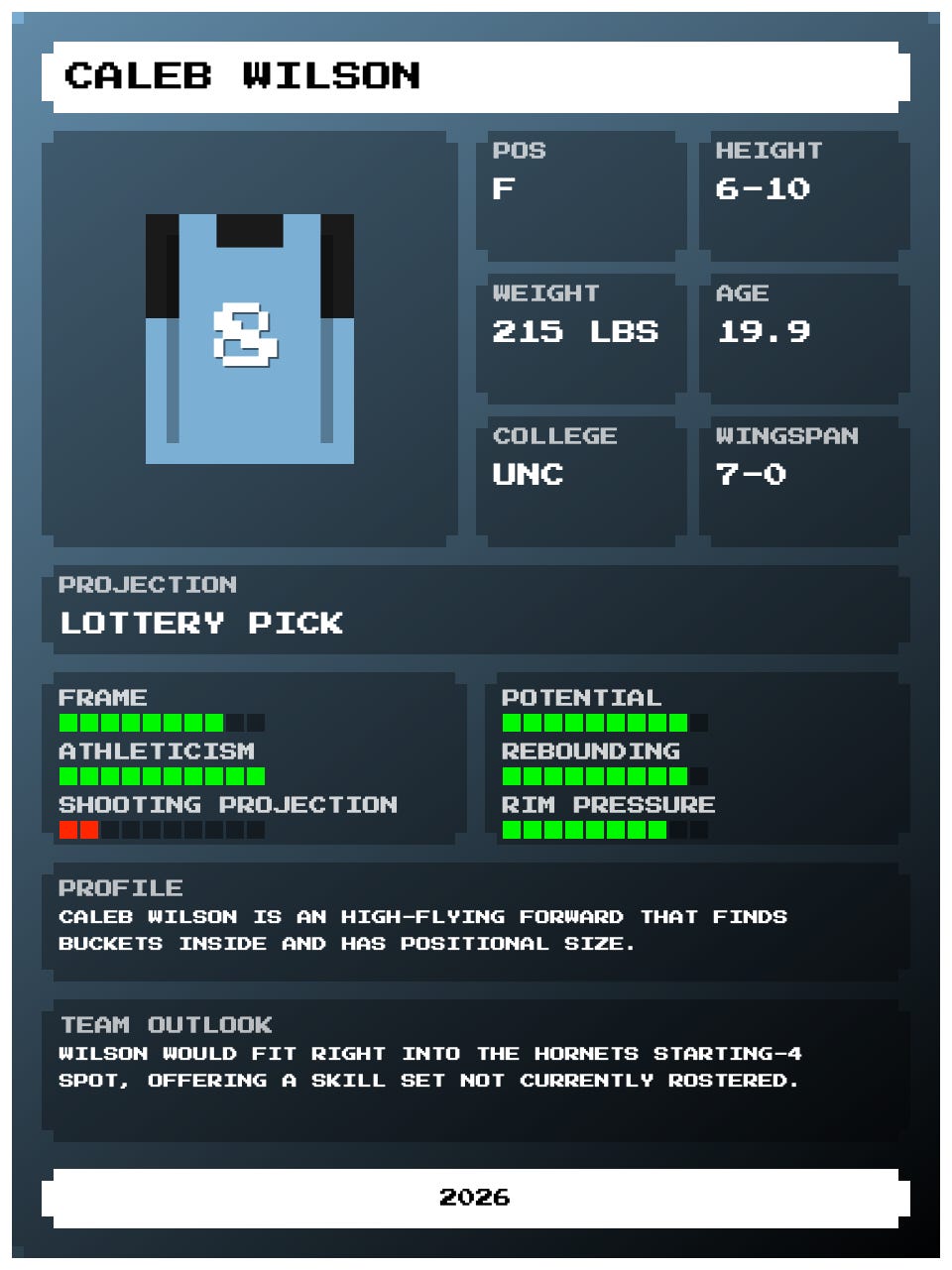
Maybe it’s the North Carolina fans. Maybe it’s just my subjective bias noticing when his name is brought up for the Hornets. Maybe it’s some other reason.
I just feel like I’ve seen the idea brought up quite a bit.
So I created an interactive tool to see what it would cost the Hornets to make such a move.
I know Charlotte has draft capital (and a lot of it), but I wanted to math-out the possibility - not just for Wilson, but for a move in general.
So I created a custom pick value chart, one which is custom to the 2026 NBA Draft.
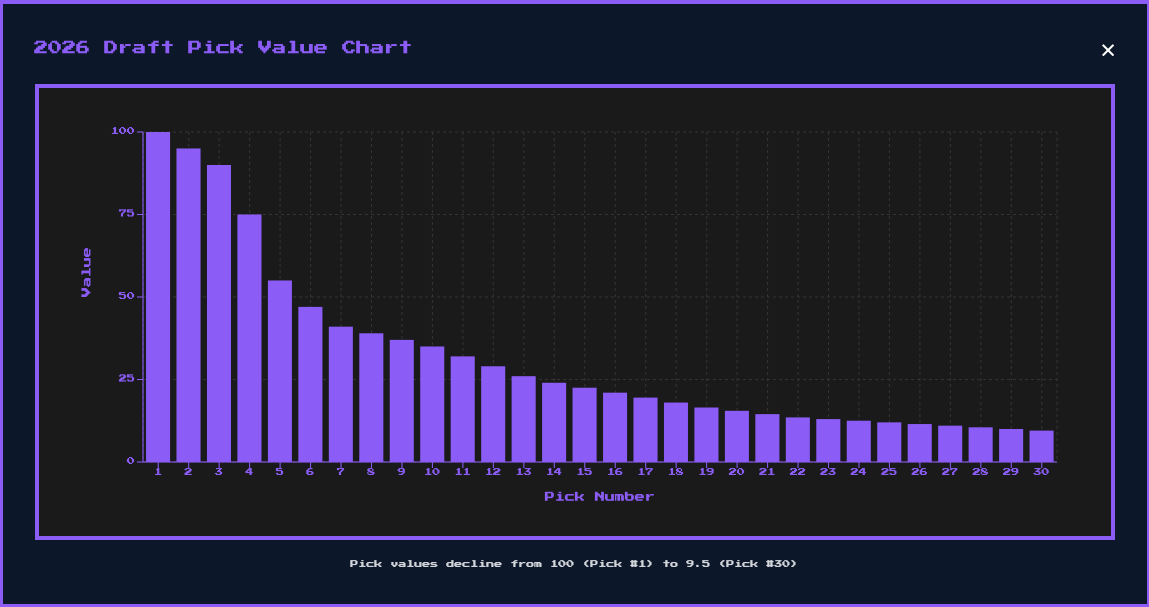
The first thing you’ll notice here is a relatively flat value for picks 1-3. With the interchangeability in order of AJ Dybantsa, Cam Boozer, Darryn Peterson, and even Caleb Wilson, the top-3 picks specifically are relatively similar in value. The order at which those players come off the board might entirely be dependent on which teams move up in the 2026 Draft Lottery - that’s a unique situation. In most classes, the curve would drop sharply after the first pick (like last year, where the value of the second pick [Dylan Harper] would be significantly less than the first pick [Cooper Flagg]).
This year, though, that drop happens in between picks 3 and 5. After that, the value stabilizes, decreasing gradually until the 30th pick.
So if you’re Jeff Peterson, and you want to move up for one of those “blue chip” selections, it’s going to cost quite a bit.
Let’s take a walk down this hypothetical for a minute:
Let’s say the lottery balls fall like this: 1. Brooklyn, 2. Memphis, 3. Atlanta (via NO), 4. Utah.
In that scenario, you’d likely see a scenario in which Caleb Wilson is on the board for the Jazz to take with the fourth pick. They already have Jaren Jackson and Walker Kessler in the front court, and spent a top-5 pick on Ace Bailey last summer. Now, they might just run the pick in for Caleb Wilson (and that’s certainly what I’d do, if I were in their shoes).
But that’s also one of the few scenarios I could see a top-4 pick actually being moved in this draft class.
And if that scenario arises, what could the cost be?
Well, per the trade simulator I created, it would look like this:
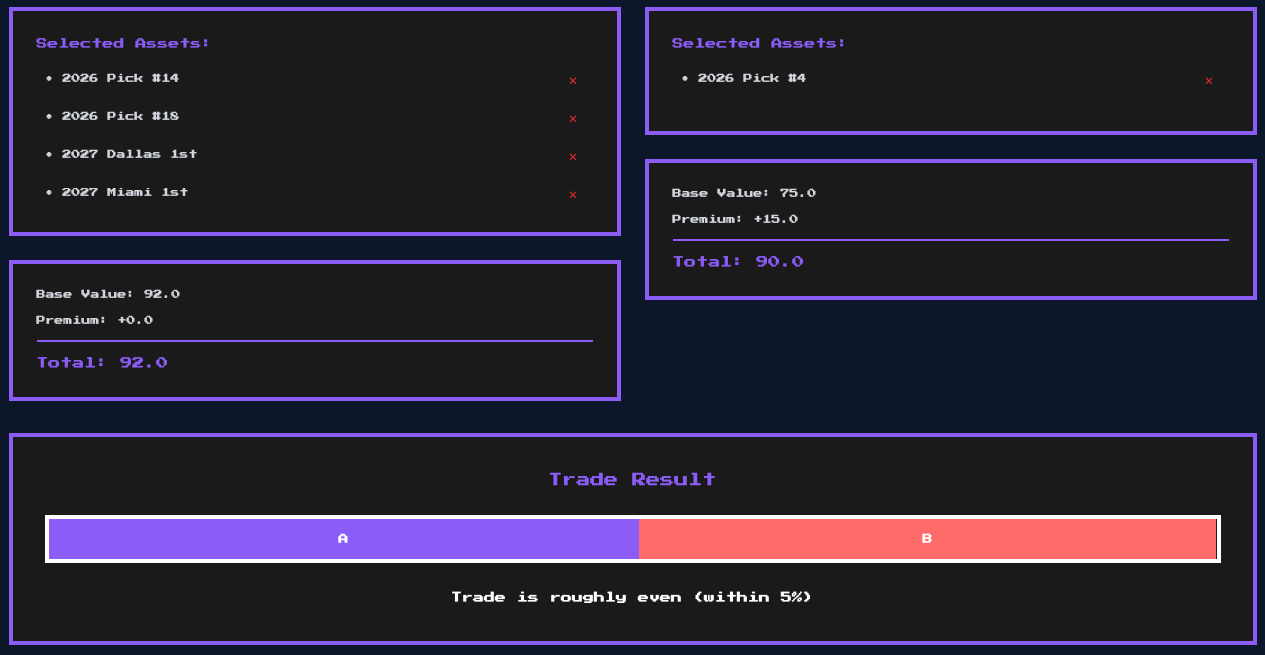
Four total first round selections, including No. 14 and No. 18, for the right to select Caleb Wilson.
And again, I must point out: This is in the rare scenario that the team holding the 4th pick is willing to trade it, which is incredibly unlikely to begin with.
Okay. That’s fine. Well how far can Charlotte move up the draft order by consolidating picks 14 and 18?
Well, let’s game it out.
Pick 14 is worth 24 points, pick 18 is worth 18 points. With a 20% value premium attached to top-10 picks, the Hornets could get as high as the 10th overall pick.
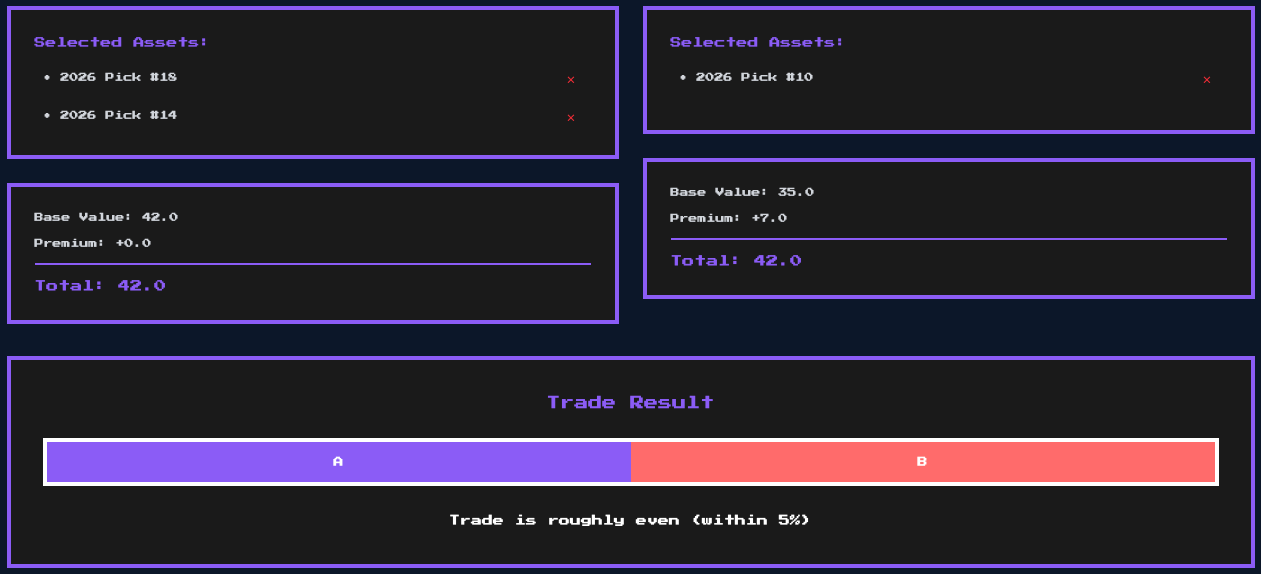
And again, that’s only if the team holding that pick is willing to move down.
But honestly?
The 10th pick is similar enough in value to the 14th pick, to where the Hornets probably can better use their assets - especially in a draft so rich with talent.
The 10th pick probably puts you in the range of Yaxel Lendeborg or Aday Mara, but would it be worth giving up a top-20 pick to move up only four spots?
It’s subjective, but the Hornets front office has repeatedly stated they do not want to “skip steps” in the team-building process.
Is a trade up realistic? Probably not.
Is it fun to think about? Absolutely.
You can try out the draft pick trade machine in our Charlotte Hornets draft guide, available now to paid SportCLT subscribers.
Will the Hornets even have room in the rotation for two first round picks? Might be better to trade 18 for a future first.